

What if building a reliable investment portfolio didn’t mean endless stock picking or market timing?
Start with a clear process instead: goals, risk tolerance, core asset classes, low-cost ETFs, target allocations, and rebalancing.
This post lays out a step-by-step framework for how to build a diversified ETF portfolio that lasts, so your mix fits your goals and weathers the next market swing.
Along the way you’ll get simple ETF categories, sample allocations, and a short checklist to keep your plan on track.
Step‑by‑Step Framework for Building a Balanced ETF Portfolio

Building a diversified ETF portfolio starts with a clear process that moves from goals to execution. You’ve got six main steps: define your investment goals and time horizon, assess your risk tolerance, select core asset classes, choose low cost ETFs that represent each asset class, set target allocations, and implement through a brokerage account. Each step builds on the previous one so your portfolio reflects both your financial objectives and your ability to handle market volatility.
Selecting core asset classes means deciding which types of investments you need for diversification. Most balanced portfolios include US equities for growth, international equities for geographic diversification, bonds for stability, and sometimes alternatives like real estate or commodities for inflation protection. Once you’ve identified the asset classes, match each to a specific ETF category. For example, a broad US market ETF for domestic stocks, a total international ETF for foreign exposure, and an aggregate bond ETF for fixed income. This matching process ensures every dollar serves a clear portfolio role.
Defining allocation percentages transforms your strategy into numbers. Common allocation ranges include 60 percent equities and 40 percent bonds for moderate risk, 80 percent equities and 20 percent bonds for growth focused investors, or 40 percent equities and 60 percent bonds for conservative portfolios. Within equities, you might split 70 percent to US stocks and 30 percent to international markets. These percentages form your target allocation, the baseline you’ll return to during rebalancing.
Implementation involves opening a brokerage account that offers commission free ETF trades, placing orders to purchase ETFs according to your target allocation, and setting a monitoring schedule. Many platforms let you track allocation drift and send alerts when a position grows beyond its target weight. After your initial purchase, monitor performance quarterly or semi annually, checking whether any asset class has drifted by more than five percent from its target. If it has, rebalance by selling the outperformers and buying the underperformers.
Complete Build Process:
- Define your investment goal (retirement, wealth accumulation, income) and time horizon (years until you need the money).
- Assess your risk tolerance by considering how much portfolio decline you can handle without abandoning the plan.
- Select core asset classes, equities, bonds, international exposure, and optional alternatives, that match your goal and tolerance.
- Choose specific ETFs with low expense ratios and high liquidity for each asset class.
- Set target allocation percentages for each ETF based on your risk profile and strategy.
- Place trades through your brokerage, then schedule regular reviews to monitor drift and rebalance when needed.
Choosing the Right Asset Classes
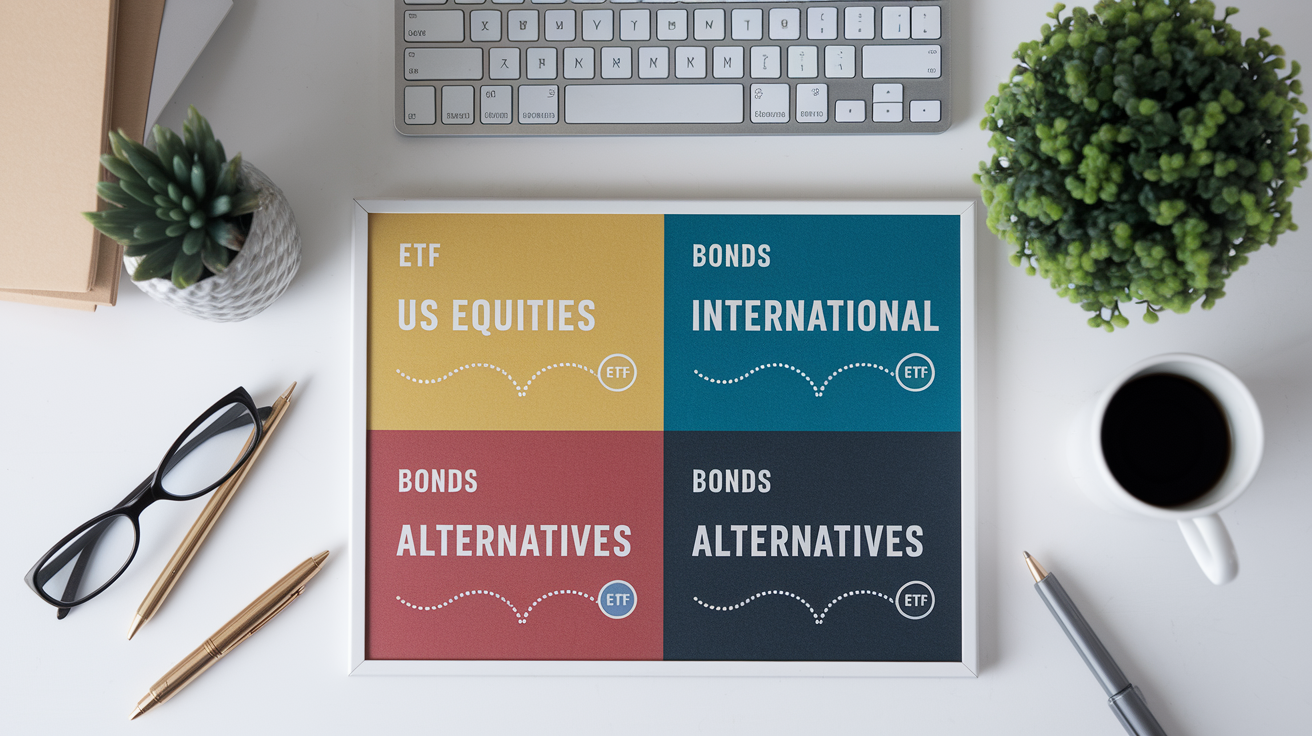
Asset class diversification is the foundation of risk control. Each asset class, US equities, international equities, bonds, and alternatives, responds differently to economic conditions. Holding multiple classes reduces the chance that one bad quarter destroys your portfolio. US equities typically offer growth but can be volatile. International equities add geographic diversification and exposure to economies that may outperform when the US lags. Bonds provide stability and income, acting as a counterbalance when stocks fall. Alternatives like real estate or commodities can hedge inflation and further reduce correlation to traditional stocks and bonds.
US equities form the growth engine for most portfolios. Broad market equity ETFs track indices like the S&P 500 or the total US stock market, giving you exposure to hundreds or thousands of companies across sectors. International equities include developed markets, Europe, Japan, Canada, and emerging markets like China, India, and Brazil. Developed market ETFs tend to be less volatile than emerging market funds but offer lower growth potential. Bond ETFs range from short term Treasuries (low risk, low return) to aggregate bond funds (a mix of government and corporate bonds) to high yield bonds (higher return, higher risk). Each bond category serves a different role depending on your need for stability versus income.
Alternatives round out diversification. Real estate ETFs invest in REITs (real estate investment trusts), providing income and inflation protection. Commodity ETFs track gold, oil, or broad commodity baskets, offering a hedge when inflation rises. Some investors add a small allocation to alternatives, often 5 to 10 percent of the portfolio, to reduce correlation with equities and bonds. The key is ensuring each asset class you select has a clear purpose and doesn’t overlap with another holding.
Main Asset Classes for ETF Portfolios:
US Equities: Growth focused exposure to domestic stocks across all sectors and market capitalizations.
International Equities: Geographic diversification through developed and emerging foreign markets.
Bonds: Stability and income via government, corporate, or aggregate bond funds.
Alternatives: Real estate, commodities, or other non traditional assets that lower correlation and hedge inflation.
Allocation Models for Diversified ETF Portfolios

Different allocation models suit different investors. The 60/40 model, 60 percent equities, 40 percent bonds, is a classic moderate risk allocation that balances growth with downside protection. The 80/20 model, 80 percent equities, 20 percent bonds, shifts toward growth, accepting higher volatility for better long term return potential. Risk based allocations use volatility or drawdown targets to set weights, often lowering exposure to high volatility assets. Age based allocations follow a rule like “bonds equal your age in years,” gradually shifting from growth to stability as you near retirement.
Choosing the right model depends on your time horizon and how much short term loss you can tolerate. If you have 20 years until retirement, an 80/20 or even 90/10 allocation may suit you because you’ve got time to recover from bear markets. If you’re within five years of needing the money, a 40/60 or 30/70 allocation, where bonds dominate, reduces the risk that a sudden market drop forces you to sell stocks at a loss. Moderate risk investors with medium term goals often settle on 60/40 as a balanced compromise.
Within each model, you can further diversify by splitting equities into US and international, or bonds into short term and aggregate. For example, a 60/40 portfolio might be 40 percent US equities, 20 percent international equities, and 40 percent aggregate bonds. An 80/20 portfolio could be 55 percent US equities, 25 percent international equities, and 20 percent short term bonds. The table below shows four common models and their typical use cases.
| Model | Equity % | Bond % | Best For |
|---|---|---|---|
| Conservative (40/60) | 40 | 60 | Near retirement investors or low risk tolerance; prioritizes capital preservation. |
| Moderate (60/40) | 60 | 40 | Balanced growth and stability; medium time horizon and moderate risk tolerance. |
| Growth (80/20) | 80 | 20 | Long term investors with higher risk tolerance; accepts volatility for better returns. |
| Aggressive (90/10) | 90 | 10 | Very long time horizon (15+ years); high risk tolerance and focus on maximum growth. |
ETF Examples for a Diversified Portfolio
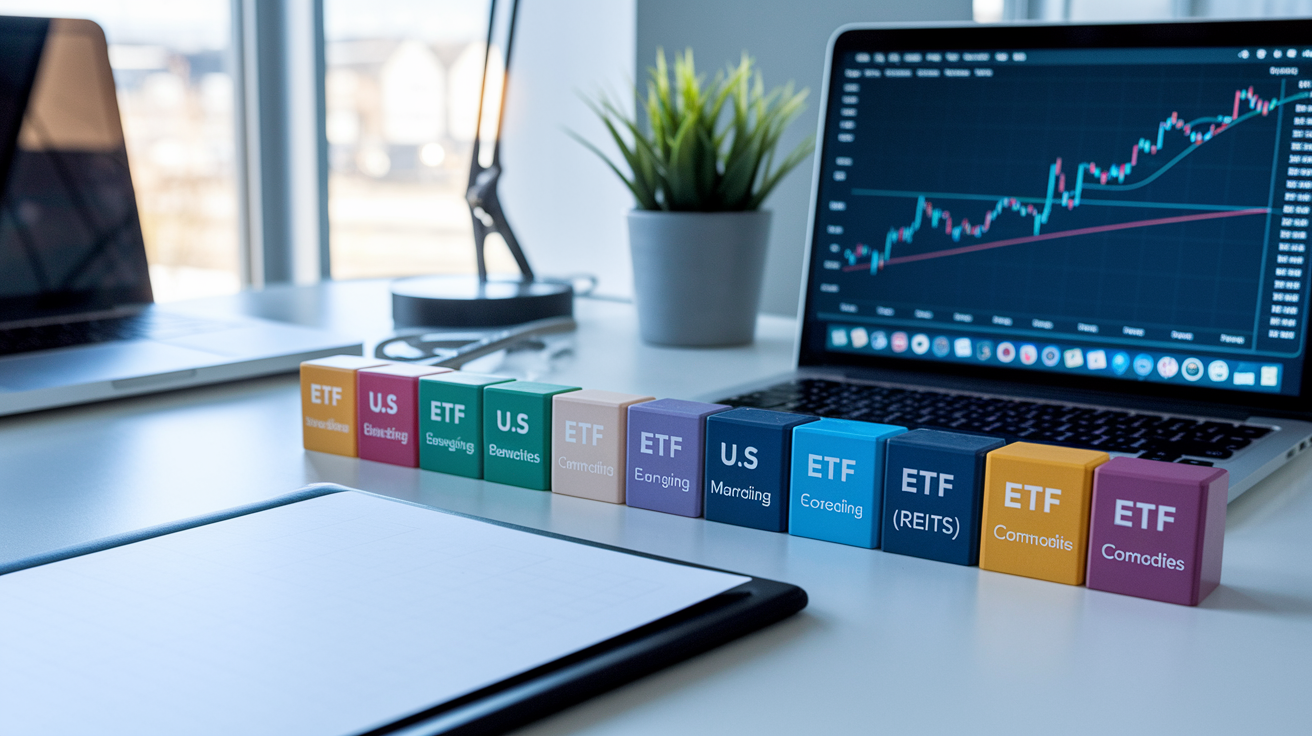
Broad market equity ETFs are the workhorses of diversified portfolios. A total US stock market ETF gives you exposure to large cap, mid cap, and small cap companies in one fund, covering the entire domestic equity market. If you prefer large cap only, an S&P 500 ETF tracks the 500 largest US companies. Both options offer low expense ratios, often below 0.10 percent, and high liquidity, making them ideal core holdings.
International equity ETFs split into developed and emerging markets. A developed market international ETF covers Europe, Japan, Australia, and other mature economies, providing geographic diversification without the volatility of emerging markets. An emerging market ETF adds exposure to faster growing but riskier economies like China, India, Brazil, and South Korea. Many investors hold both, allocating roughly two thirds of their international equity exposure to developed markets and one third to emerging markets.
Bond ETFs and alternatives complete the portfolio. An aggregate bond ETF holds a mix of government and investment grade corporate bonds, offering broad fixed income exposure with moderate risk. A short term Treasury ETF provides stability with minimal interest rate risk, useful for conservative portfolios or as a cash substitute. Real estate ETFs invest in REITs, giving you income and inflation protection, while commodity ETFs like gold funds act as a hedge during periods of rising inflation or market stress.
ETF Categories for Building Blocks:
Total US Stock Market: Single fund exposure to the entire domestic equity market across all sizes.
International Developed Markets: Geographic diversification through stable, mature foreign economies.
Emerging Markets: Higher growth exposure to developing economies with increased volatility.
Aggregate Bonds: Broad fixed income coverage via government and corporate bonds for stability.
Real Estate (REITs): Income and inflation hedge through property investment trusts.
Managing Risk in an ETF Portfolio

Risk management starts with diversification across asset classes, geographies, and sectors. Holding only US large cap stocks exposes you to concentration risk. If tech or financials stumble, your entire portfolio suffers. Adding international equities, bonds, and alternatives spreads risk so no single market or sector can sink your returns. Bonds are particularly important because they often rise or hold steady when stocks fall, reducing overall portfolio volatility. A 60/40 portfolio typically experiences smaller drawdowns than a 100 percent equity portfolio, even though it sacrifices some upside.
Allocation discipline is the second pillar of risk control. Once you set target allocations, stick to them unless your goals or risk tolerance change. Markets will tempt you to chase recent winners, loading up on tech ETFs after a strong year, for example, but that increases concentration and drift. Monitor your portfolio regularly to ensure no single position has grown beyond its target weight by more than five or ten percent. If it has, rebalance by trimming the winner and adding to laggards. This counterintuitive behavior, selling strength, buying weakness, keeps your risk profile stable and prevents emotional decision making during market extremes.
Rebalancing Strategies

Rebalancing restores your target allocation after market movements push asset classes out of balance. If your 60/40 portfolio drifts to 70/30 because equities outperformed, rebalancing means selling some equity ETFs and buying bond ETFs to return to 60/40. This process locks in gains from the outperformer and buys the underperformer at a relative discount, maintaining your intended risk level. Without rebalancing, a portfolio can become much riskier than you planned. If equities keep rising, you might end up with 80 percent stocks and face a larger drawdown when the market corrects.
Two common rebalancing methods are calendar based and threshold based. Calendar based rebalancing happens on a fixed schedule, annually, semi annually, or quarterly, regardless of how far allocations have drifted. It’s simple and disciplined, requiring no constant monitoring. Threshold based rebalancing triggers when an asset class moves beyond a set percentage from its target, often five percent. For example, if your target is 60 percent equities and the actual allocation reaches 65 percent or 55 percent, you rebalance. Threshold based rebalancing can be more tax efficient because it avoids unnecessary trades, but it requires regular monitoring.
Three Rebalancing Methods:
- Annual Calendar Rebalancing: Review and adjust allocations once per year on a set date, regardless of drift size.
- Quarterly Calendar Rebalancing: Check allocations every three months and rebalance to targets if any drift occurred.
- Threshold Based Rebalancing: Monitor continuously and rebalance only when an asset class drifts by five or ten percent from its target weight.
Tax Efficient ETF Investing

ETFs are generally more tax efficient than mutual funds because of their in kind creation and redemption process. When an authorized participant exchanges underlying securities for ETF shares, or vice versa, no taxable sale occurs. This structure minimizes capital gains distributions, especially in broad market index ETFs. Most equity ETFs distribute little or no capital gains each year, letting you defer taxes until you sell shares. Bond ETFs and dividend focused equity ETFs still generate taxable income, but the structural advantage remains.
Tax loss harvesting is a strategy that turns losses into tax savings. If an ETF in your taxable account falls below your purchase price, you can sell it to realize the loss, then buy a similar but not identical ETF to maintain your allocation. The loss offsets other capital gains or up to three thousand dollars of ordinary income per year. For example, if you hold a total US market ETF that’s down, you could sell it and immediately buy an S&P 500 ETF or an extended market ETF to keep equity exposure while harvesting the loss. Be aware of the wash sale rule. You can’t buy a “substantially identical” security within 30 days before or after the sale, or the loss is disallowed.
Tips for Minimizing Taxes:
Hold bond ETFs and high dividend equity ETFs in tax advantaged accounts like IRAs or 401(k)s to defer income taxes.
Use tax loss harvesting in taxable accounts to offset gains and reduce your annual tax bill.
Favor broad market index ETFs in taxable accounts because they generate fewer capital gains distributions than actively managed funds.
Tools and Platforms for Building ETF Portfolios
Most online brokerages now offer commission free ETF trading, removing a major cost barrier. Platforms like Vanguard, Fidelity, Charles Schwab, and others let you buy and sell ETFs without transaction fees, making frequent rebalancing affordable. Many also provide fractional shares, so you can invest small amounts and maintain precise target allocations even with limited capital. Look for platforms that offer integrated portfolio tracking, showing your current allocation versus your targets and flagging when drift exceeds your threshold.
Portfolio tools and screeners help you select ETFs and monitor performance. ETF screeners let you filter by asset class, expense ratio, liquidity, and tracking index, narrowing thousands of funds to a short list that matches your criteria. Portfolio trackers, available through brokerages or third party services, calculate allocation drift, performance attribution, and tax loss harvesting opportunities. Some platforms offer automated rebalancing, where the system sells and buys ETFs to restore target allocations on a schedule you set. These tools reduce manual work and help you stay disciplined, especially during volatile markets when emotional decisions are tempting.
Common Mistakes When Building ETF Portfolios

Over diversifying is a frequent error. Holding ten equity ETFs that all track similar indices, like an S&P 500 fund, a large cap growth fund, and a total market fund, adds complexity without reducing risk. Each fund overlaps heavily with the others, so you gain little diversification benefit while increasing monitoring burden. A simpler approach, one broad US equity ETF, one international equity ETF, one bond ETF, often delivers the same diversification with less clutter.
Chasing performance means loading up on last year’s winners, expecting the trend to continue. If small cap value ETFs outperformed last year, new investors often pile in, ignoring that valuations have already risen and future returns may be lower. Performance chasing increases concentration risk and often leads to buying high and selling low when the trend reverses. Ignoring costs is another mistake. Paying 0.50 percent for an actively managed ETF when a 0.03 percent index ETF offers similar exposure wastes returns over decades. Failing to rebalance lets your portfolio drift far from its intended risk profile, turning a 60/40 allocation into 80/20 without you realizing it. Each of these mistakes is avoidable with a clear plan and regular discipline.
Most Common ETF Portfolio Mistakes:
Over diversification: Holding too many overlapping ETFs that provide no additional risk reduction.
Performance chasing: Buying recent top performers at inflated valuations instead of sticking to long term allocation targets.
Ignoring costs: Choosing high expense ratio ETFs when low cost alternatives offer similar exposure.
Neglecting rebalancing: Allowing portfolio drift to change your risk profile unintentionally, often increasing equity exposure beyond your tolerance.
Final Words
We walked through a clear, step-by-step framework: pick core asset classes, match low-cost ETFs, set target allocations like 60/40 or 80/20, then implement through a broker and monitor performance.
That process matters because it turns big ideas into repeatable actions that reduce single-asset risk, control costs, and smooth long-term returns. Watch rebalancing triggers, tax efficiency, and platform fees.
Start with the six-step build, pick sensible allocations, and review annually. This practical playbook shows how to build a diversified etf portfolio in a steady, repeatable way, so your plan can outlast the headlines.
FAQ
Q: What is a good diversified ETF portfolio?
A: A good diversified ETF portfolio mixes broad U.S. equities, international equities, and bonds sized to your goals and risk tolerance, using low-cost ETFs and regular rebalancing to control risk and costs.
Q: What is the 3 5 10 rule for ETFs? What is Warren Buffett’s 90/10 rule? What is the 70/30 ETF strategy?
A: The 3-5-10 rule suggests building ETF portfolios with 3, 5, or 10 funds for rising diversification; Buffett’s 90/10 allocates 90% stocks and 10% bonds; 70/30 means 70% equities and 30% bonds.