

Global recessions start when credit freezes, trade slumps, and policy errors lock major economies together.
That sounds dramatic, but in 2008 and 2020 those forces turned local shocks into a worldwide downturn.
This post walks through the core mechanics — financial crises, demand shocks, supply‑chain breakdowns and policy mistakes — explains why each matters for portfolios, and gives a short watchlist of signals to follow next.
Watch credit spreads, world trade volumes, central bank rate moves, and commodity prices for early warning signs.
Core Mechanics Behind How Global Recessions Begin
A global recession happens when major economies contract at the same time, producing a sustained drop in world GDP and trade that no single country can escape by itself. Unlike a national downturn, where neighbors can keep buying exports and provide capital, a global recession closes all those escape routes at once. The International Monetary Fund has recorded only a handful of true global recessions since World War II. 1975, 1982, 1991, 2008, and 2020. The bar is high: most of the world’s economic output must shrink together.
Financial crises are the most powerful trigger. When asset bubbles burst and banking losses mount, credit freezes. Households and businesses lose access to loans, investment grinds to a halt, and the real economy contracts sharply. The 2007–2009 crisis illustrated this path. The U.S. housing downturn began in 2006, escalated into systemic stress by 2007, and culminated in the collapse of Lehman Brothers on September 15, 2008. The S&P 500 fell roughly 57 percent from its October 2007 peak to the March 2009 trough. World merchandise trade volume dropped about 12.2 percent in 2009. U.S. unemployment peaked at 10.0 percent in October 2009.
Demand shocks and supply chain disruptions also turn local problems into global downturns. The COVID-19 pandemic caused a synchronized collapse in consumer spending and production. Global GDP contracted by approximately 3.3 percent in 2020, the VIX volatility index spiked to around 82 on March 16, 2020, and governments launched emergency fiscal packages. The U.S. CARES Act alone totaled roughly $2.2 trillion in March 2020. Supply shocks, such as sharp commodity price increases or trade restrictions, raise costs across borders, reduce real incomes, and force central banks to tighten policy. That compounds the downturn.
Policy errors frequently accelerate recessions that might otherwise remain regional. Abrupt monetary tightening to fight inflation can choke off credit and tip fragile economies into recession. Premature fiscal austerity withdraws demand just as private sector confidence is falling, deepening the contraction. When several major economies make the same mistake at the same time, a global recession follows.
The four primary trigger categories are:
Financial crises: asset bubbles, banking losses, and credit crunches that freeze lending.
Demand shocks: pandemics, sharp fiscal tightening, or sudden drops in consumer and business spending.
Supply and trade disruptions: commodity price shocks, energy crises, or supply chain breaks that raise costs and reduce output.
Policy mistakes: poorly timed monetary tightening or premature fiscal consolidation that withdraws support too soon.
Financial System Fragilities That Start Global Recessions

Leverage builds quietly during expansions. Banks, shadow lenders, and households borrow heavily to chase rising asset prices. Property values climb, stock valuations stretch, and credit standards loosen. When a shock arrives (rising interest rates, a geopolitical event, or a credit default) asset prices fall, collateral values drop, and lenders pull back. What looked like a stable financial system turns out to be fragile because everyone borrowed against the same optimistic assumptions.
Credit crunches spread internationally through cross-border banking linkages and capital flows. A bank failure in one country triggers margin calls and forced selling in others. Investors pull money out of emerging markets and peripheral economies, causing currency crises and liquidity shortages. Global banks freeze interbank lending, and firms that rely on short-term credit (even healthy ones) can’t roll over their debt. The liquidity crisis becomes a solvency crisis, and the downturn deepens.
Bank failures destroy confidence and reduce the supply of credit across the entire world economy. When large institutions collapse, depositors and investors question the safety of all banks. Lending standards tighten sharply, investment projects are canceled, and hiring stops. The real economy contracts because credit is the fuel for expansion. Without it, even profitable businesses can’t grow.
| Trigger | Transmission Mechanism | Notable Historical Example |
|---|---|---|
| Housing bubble collapse | Mortgage defaults → bank losses → credit freeze → global interbank lending halt | 2007–2009 U.S. subprime crisis spreading to Europe and Asia |
| Leveraged banking sector | Cross-border exposures → cascading failures → capital flight from emerging markets | 1997–1998 Asian financial crisis |
| Shadow banking liquidity run | Money-market funds break the buck → commercial paper freeze → corporate credit dries up | September 2008 Reserve Primary Fund failure |
| Stock market crash | Wealth destruction → confidence collapse → consumption and investment drop globally | October 1929 U.S. crash spreading to Europe |
Trade, Supply Chains, and How Global Recessions Spread Across Borders

Trade linkages turn a recession in one large economy into a downturn for its trading partners. When U.S. or European consumers stop buying, factories in Asia lose orders, cut production, and lay off workers. Those workers then reduce their own spending, and the contraction feeds back through regional supply chains. A 5 to 10 percent year-over-year decline in world trade volumes is a red flag that recession is spreading globally. In 2009, world merchandise trade fell by approximately 12.2 percent as demand collapsed across borders.
Integrated supply chains amplify the shock. Modern production relies on intermediate goods crossing multiple borders before final assembly. A disruption in one country (a port closure, a shortage of semiconductors, a spike in shipping costs) halts production elsewhere. Firms can’t deliver finished goods, revenues fall, and layoffs follow. The 2020 pandemic illustrated this dynamic. Lockdowns in China and Europe caused supply shortages in the U.S., and vice versa, creating a synchronized global downturn.
The stages of trade driven recession amplification:
Export demand declines in a major economy due to domestic recession or policy shock.
Supply chain delays and input shortages emerge as cross-border flows slow or stop.
Production drops in exporting countries, reducing output and industrial employment.
Layoffs accelerate, cutting household incomes and local consumption.
Investment collapses as firms cancel expansion plans, deepening the downturn across all trading partners.
Macro Policy Triggers That Set Global Recessions in Motion

Monetary tightening is designed to control inflation, but abrupt or synchronized rate hikes can tip the global economy into recession. When the Federal Reserve, the European Central Bank, and other major central banks raise rates at the same time, borrowing costs rise everywhere. Credit sensitive sectors (housing, autos, capital goods) contract first. If tightening continues too long or moves too fast, the downturn spreads to labor markets, consumption falls, and the recession becomes self-reinforcing. The Fed cut rates to 0 to 0.25 percent in December 2008 and again in March 2020 after earlier tightening cycles contributed to financial stress.
Fiscal austerity imposed during or just after a downturn withdraws demand when private spending is already weak. Governments cut spending or raise taxes to reduce deficits, but the immediate effect is lower GDP growth, higher unemployment, and falling tax revenues that can worsen the fiscal position. When multiple countries pursue austerity at once (common after financial crises) the global economy loses a critical source of demand, and recession deepens. The 2010–2012 European sovereign debt crisis showed how premature fiscal consolidation prolonged the downturn across the continent.
Policy coordination is difficult because national interests and economic cycles don’t always align. One country may need stimulus while another fights inflation. Exchange rate effects mean that monetary easing in one nation can tighten conditions elsewhere through currency appreciation. Without coordinated action (such as the central bank swap lines and joint fiscal responses during 2008 and 2020) local policy mistakes more easily cascade into global recessions.
Historical Case Studies Showing How Global Recessions Start
2007–2009 Global Financial Crisis
The crisis began with risky mortgage lending in the United States. Subprime borrowers received loans they couldn’t afford, packaged into complex securities and sold worldwide. When U.S. housing prices peaked in 2006 and began falling in 2007, defaults rose, and the value of mortgage backed securities collapsed. Financial institutions holding these assets faced large losses, and trust in the banking system evaporated.
Lehman Brothers filed for bankruptcy on September 15, 2008. That was the tipping point that turned a credit crunch into a global panic. Interbank lending froze, credit markets seized, and stock prices plunged. The S&P 500 lost roughly 57 percent from its October 2007 peak to the March 2009 trough. World merchandise trade volume fell about 12.2 percent in 2009 as demand collapsed across borders.
The downturn hit labor markets hard. U.S. unemployment peaked at 10.0 percent in October 2009, and joblessness rose sharply in Europe and other advanced economies. Central banks slashed rates. The Federal Reserve cut to 0 to 0.25 percent in December 2008 and launched large scale asset purchases. Fiscal stimulus packages followed, but the recovery was slow and uneven. Some countries took years to return to pre-crisis employment levels.
1970s–1980s Oil and Inflation Shocks
The 1973 oil embargo and subsequent oil price shocks triggered a global recession by raising energy costs sharply and suddenly. Inflation surged, central banks tightened monetary policy to fight rising prices, and growth slowed. The combination of high inflation and stagnant output (stagflation) made policy responses difficult because traditional stimulus risked worsening inflation.
The early 1980s recession followed another round of oil price increases and aggressive monetary tightening. The Federal Reserve under Paul Volcker raised rates dramatically to break inflation expectations, pushing the U.S. and other major economies into recession. High interest rates also caused a debt crisis in emerging markets, deepening the global downturn and illustrating how domestic policy choices transmit internationally through capital flows and trade.
2020 COVID-19 Global Recession
The pandemic caused the most severe global recession since the Great Depression. Governments imposed lockdowns to control the virus, and economic activity collapsed almost overnight. Global GDP contracted by approximately 3.3 percent in 2020, far worse than the 2008–2009 downturn in speed and breadth.
Financial markets reacted violently. The VIX volatility index spiked to around 82 on March 16, 2020, reflecting extreme uncertainty. Stock prices fell sharply, and credit markets froze until central banks intervened with emergency liquidity facilities and rate cuts. The Federal Reserve, European Central Bank, and other major central banks cut rates and launched large scale asset purchases in March 2020 to stabilize financial conditions.
Key impact metrics from the 2020 recession:
Global GDP: contracted about 3.3 percent in 2020 (IMF estimate).
U.S. fiscal response: CARES Act totaled roughly $2.2 trillion in emergency support (March 2020).
Market volatility: VIX reached approximately 82 on March 16, 2020, one of the highest readings on record.
Early Warning Signals That Reveal How Global Recessions Start
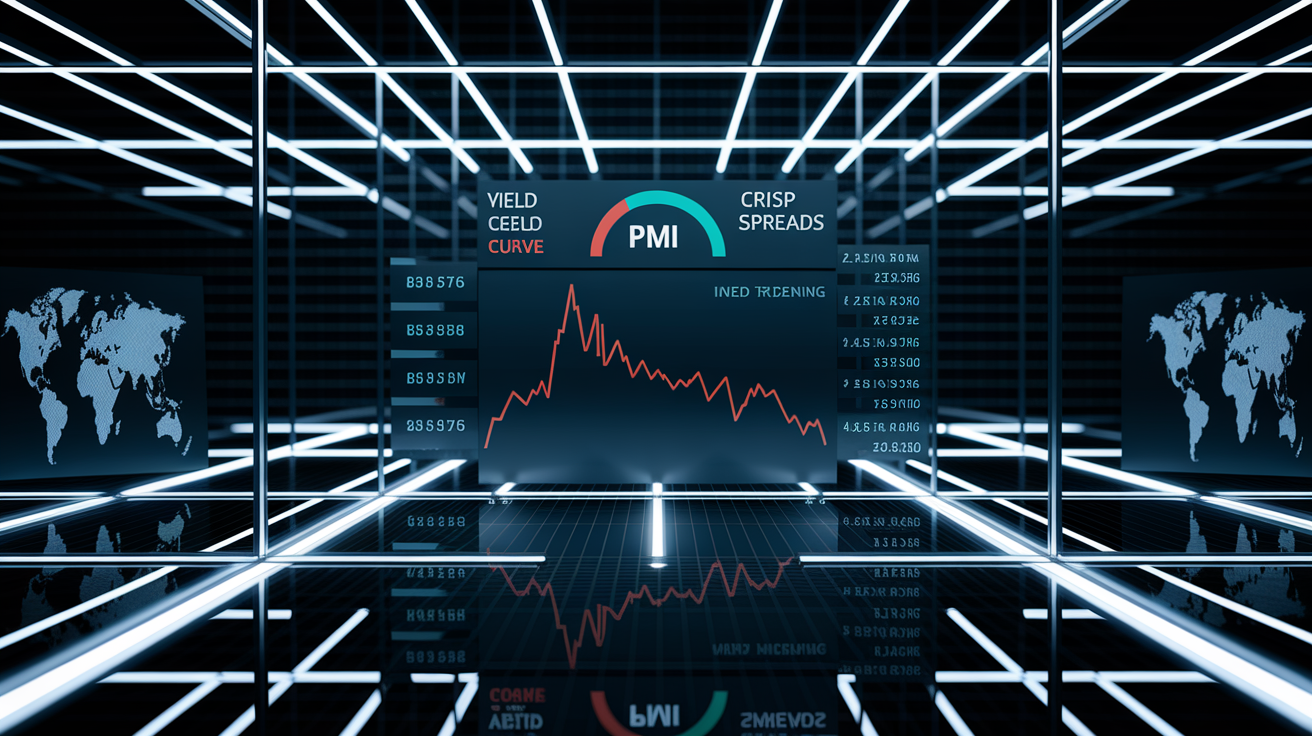
Economists track a set of quantitative indicators that tend to signal recession risk months in advance. These measures capture stress in credit markets, manufacturing activity, labor markets, and investor sentiment. No single indicator predicts recessions with certainty, but several flashing warning signs at once raise the probability sharply.
The yield curve is one of the most reliable leading indicators. When the spread between 10 year and 2 year U.S. Treasury yields turns negative (an inversion), a recession has followed within 12 to 24 months in nearly every case since 1955. The inversion signals that investors expect weaker growth and lower interest rates in the future. It also mechanically tightens credit conditions by squeezing bank lending margins. Manufacturing surveys, such as the ISM Purchasing Managers Index, provide real time snapshots of business activity. A PMI reading below 50 indicates contraction, and sustained readings in that territory often precede broader economic downturns.
| Indicator | Threshold | Why It Matters |
|---|---|---|
| Yield curve (10y–2y spread) | Turns negative (inversion) | Historically precedes U.S. recessions; signals investor expectations of slower growth and lower future rates |
| Manufacturing PMI | Falls below 50 | Indicates contraction in factory activity and often leads broader economic weakness |
| Credit growth | Turns negative or slows sharply | Bank lending downturn reduces business investment and household spending |
| Corporate credit spreads | Widen by +200 to +400 basis points | Rising borrowing costs signal financial stress and increase default risk |
| World trade volumes | Decline >5–10% year-over-year | Sharp trade contraction indicates synchronized global demand weakness |
| Equity drawdown and VIX | Stocks fall >20%; VIX >40 | Wealth destruction, confidence collapse, and elevated uncertainty reduce spending and investment |
Global Recession Policy Responses and Their Limits

Central banks typically cut interest rates aggressively once recession signals appear, often driving policy rates to near zero. The Federal Reserve lowered rates to 0 to 0.25 percent in December 2008 and again in March 2020. When conventional rate cuts reach their limit, central banks launch quantitative easing. That’s large scale purchases of government bonds and other assets to inject liquidity and lower long-term borrowing costs. Swap lines between major central banks provide dollar funding to foreign banks, preventing liquidity crises from spreading internationally.
Fiscal policy plays a critical role when monetary policy alone can’t stabilize demand. Governments expand unemployment benefits, send direct payments to households, and support businesses through grants and loan guarantees. The U.S. CARES Act, passed in March 2020, totaled approximately $2.2 trillion and provided emergency relief across the economy. Coordinated fiscal responses amplify the impact because one country’s stimulus supports demand for its trading partners’ exports, creating positive spillovers.
Policy effectiveness faces several constraints:
Limited fiscal space: high public debt levels restrict the size and duration of stimulus programs, especially in countries with weak fiscal credibility.
Debt sustainability concerns: large deficits and rising debt to GDP ratios can trigger market anxiety, raise borrowing costs, and limit future policy options.
Inflation and asset price side effects: prolonged low rates and large scale asset purchases can fuel inflation or create financial imbalances, forcing policymakers to tighten before the recovery is secure.
Final Words
When growth across major economies falls at once, this piece mapped the mechanics: financial fragilities, demand and supply shocks, trade linkages, and policy mistakes.
Those channels can freeze credit, shrink trade, and turn local shocks global. We covered 2008 and 2020, early warning signs, and policy responses and their limits.
Watch yields, credit spreads, the purchasing managers index (PMI), and trade volumes. Understanding how global recessions start helps you stay calmer, keep portfolio choices grounded, and spot better opportunities as markets shift.
FAQ
Q: What causes a global recession?
A: A global recession is caused by synchronized contractions across major economies, usually triggered by financial crises, large demand shocks, major supply‑chain breaks, or policy mistakes that freeze credit and cut trade and investment.
Q: Is there a global recession coming in 2026?
A: A global recession coming in 2026 is uncertain; it depends on growth, central‑bank tightening, trade shocks, and fiscal responses. Watch the yield curve, PMIs, world trade, and credit spreads for stronger signals.
Q: What did Elon Musk say about a recession?
A: Elon Musk said a recession was possible or likely, pointing to slowing demand, hiring freezes, and cost cuts as warning signs, while emphasizing uncertainty about exact timing and severity.
Q: What are the big 4 recession indicators?
A: The big four recession indicators are yield‑curve inversion (10y–2y), rising unemployment, sustained manufacturing weakness/PMI below 50, and widening credit spreads or meaningful drops in world trade.