

Want a simpler, steadier way to invest than trying to time the market?
Dollar cost averaging into ETFs means you invest a fixed dollar amount on a schedule, buying more shares when prices fall and fewer when they rise.
It removes the “when should I invest?” question and turns emotion into routine.
Thesis: used with low-cost, diversified ETFs and a dose of discipline, DCA is a practical way to build wealth consistently without guessing the next market peak.
Watch for fees, ETF selection, and the temptation to interrupt the plan.
Core Guide to Using Dollar Cost Averaging for ETF Investing
Dollar cost averaging means you invest a fixed dollar amount into one or more ETFs at regular intervals, whether that’s weekly, fortnightly, monthly, or quarterly, no matter what the price looks like. Instead of trying to time the market or throwing a lump sum in all at once, you commit a set amount on a schedule. The strategy automatically picks up more units when prices are low and fewer when they’re high, which smooths your average cost per unit over time. This removes the whole “when should I invest?” question and replaces it with “invest on schedule.”
Here’s how the math actually works. Say you put in $1,000 per month for three months into a broad market ETF. Month one the ETF’s at $20, month two it’s $25, and month three it drops to $15. Your fixed $1,000 gets you:
- Month 1: $1,000 ÷ $20 = 50.000 units
- Month 2: $1,000 ÷ $25 = 40.000 units
- Month 3: $1,000 ÷ $15 = 66.666 units
Total invested is $3,000. Total units is 156.666. Your average cost per unit works out to about $19.14. Notice your average sits below two of the three prices you actually paid. That’s the mechanical edge of dollar cost averaging. When prices drop, your fixed amount captures more units, dragging your average cost downward even as the market bounces around. Over years and decades, this price averaging effect combines with the long term upward drift of equity and bond markets to build wealth without needing to predict short term swings.
The strategy also smooths volatility at the emotional level. Markets can swing 10 or 20 percent in a few months, and that triggers fear or excitement. Dollar cost averaging turns those swings into opportunities to stack units rather than decisions you have to make. You’re buying in the dip and you’re buying at the peak, but your schedule keeps you invested and your average cost reflects the full range of prices you encountered. For ETF investors, this discipline is powerful because ETFs give you instant diversification across dozens or hundreds of holdings, meaning each monthly contribution spreads risk across sectors, geographies, or asset classes from day one.
Practical Steps for Starting a Dollar Cost Averaging Plan with ETFs

Setting up a dollar cost averaging plan is straightforward if you follow a simple sequence. The goal is to automate as much as possible so the plan runs without needing monthly attention or willpower. Start by deciding two numbers: how much you’ll contribute each period and how often. Common frequencies are weekly (if it lines up with your pay), fortnightly, monthly, or quarterly. Monthly is the most popular because it matches salary deposits and keeps record keeping simple. Contribution amounts vary. Some investors start with $50 or $100 per month, others commit $500 or $1,000. The floor is usually set by your broker’s minimum trade size or by the bite that brokerage fees take, which we’ll cover later. A practical minimum to consider is around $100 per contribution to keep fee drag reasonable.
Next, open a brokerage account that supports recurring transfers and fractional ETF share purchases. Most modern platforms let you link a bank account and schedule automatic debits. You might set up a monthly BPAY transfer with a biller code and reference number, or authorize the broker to pull funds directly on the 15th of each month. Confirm your broker offers fractional shares, which means you can invest an exact dollar amount (say $100) without needing to buy only whole units of an ETF that costs $50 or $200 per share. Fractional share support ensures every dollar is put to work right away instead of sitting as uninvested cash.
Once the account is funded and the recurring transfer is active, select one or more ETFs that fit your risk tolerance and investment horizon. Broad market equity ETFs, total bond market ETFs, or diversified international ETFs are typical starting points. Avoid niche sector funds or leveraged products when you’re beginning a dollar cost averaging plan. Simplicity and diversification matter more than chasing short term themes. After choosing your ETFs, place your first purchase and then let automation handle the rest. Most brokers let you set a standing order that executes a market or limit order on a fixed day each month using the cash that arrives from your recurring transfer.
Here’s the five step setup:
- Step 1: Decide your contribution amount and frequency (like $100 monthly).
- Step 2: Open a brokerage account with low fees, fractional shares, and recurring transfer support.
- Step 3: Link your bank account and schedule automatic debits or BPAY transfers.
- Step 4: Select one to three core ETFs that provide broad diversification and low expense ratios.
- Step 5: Place your first trade and activate recurring purchase orders or reminders to execute trades manually each period.
ETF Selection Criteria for a Successful DCA Portfolio

The ETFs you choose will determine your long term returns, risk exposure, and cost drag, so selection deserves careful thought. Prioritize low cost, highly liquid funds that track broad indexes rather than narrow themes. A total stock market ETF, an S&P 500 index ETF, an all world ex U.S. equity ETF, or an aggregate bond ETF are all sensible building blocks. These funds hold hundreds or thousands of individual securities, spreading risk and reducing the impact of any single company’s poor performance. Low management fees preserve more of your returns over time.
Expense ratios vary, and even small differences compound significantly. An ETF charging 0.02 percent costs you $2 per year for every $10,000 invested. A fund at 0.03 percent costs $3 per $10,000, and one at 0.09 percent costs $9 per $10,000. Over 20 or 30 years, the difference between a 0.02 percent expense ratio and a 0.09 percent ratio can amount to thousands of dollars on a modest portfolio. Always compare expense ratios when evaluating similar funds. Tight bid–ask spreads also matter because they represent the hidden cost of entering and exiting a position. An ETF with a one cent spread is cheaper to trade than one with a five cent spread, especially when you’re making dozens of small purchases over time.
Distribution schedules are another practical consideration. Most broad market ETFs pay quarterly distributions (dividends from underlying stocks or interest from bonds). Knowing when distributions arrive helps you plan whether to take them as cash or reinvest them, a decision we’ll explore later. Some platforms publish distribution calendars for major ETFs, making it easy to see which months will deliver extra cash into your account.
When screening ETFs, use this four point checklist:
- Expense ratio: Target funds charging 0.10 percent or less. Best in class are below 0.05 percent.
- Liquidity and spreads: Confirm average daily volume exceeds several million dollars and bid–ask spreads are narrow (a few cents or less).
- Diversification: Prefer funds holding at least 100 securities across multiple sectors or countries.
- Distribution schedule: Check that the ETF publishes a clear quarterly or annual distribution calendar so you can plan cash flow and reinvestment.
Comparing DCA vs Lump Sum Investing in ETFs

Dollar cost averaging and lump sum investing represent two different approaches to deploying capital. A lump sum means investing all available cash immediately in one transaction. Historical studies, including research from Vanguard, show that lump sum investing outperformed dollar cost averaging in roughly 64 percent of rolling periods when markets trended upward over time. The reason is straightforward: markets tend to rise more often than they fall, so money invested earlier benefits from more days of compounding gains. If you’ve got $12,000 sitting in cash and you invest it all on January 1, that full amount participates in any January to December rally. If you spread the same $12,000 across twelve $1,000 monthly purchases, only a fraction of your capital is invested early in the year.
That statistical edge for lump sum investing comes with a caveat. It assumes you’ve got the emotional fortitude to deploy a large sum immediately and the conviction to ignore short term volatility. Many investors struggle with both. Dollar cost averaging reduces regret and timing risk. If you invest $12,000 on January 1 and the market drops 15 percent in February, you experience the full drawdown and might panic. If you spread that $12,000 across the year, a February dip means your February and March contributions buy units at lower prices, softening the psychological blow and improving your average cost. The trade off is clear: lump sum investing maximizes expected return in rising markets, dollar cost averaging maximizes behavioral consistency and reduces the chance of a poorly timed single entry.
| Method | Strengths | Weaknesses |
|---|---|---|
| Dollar Cost Averaging | Reduces timing risk, smooths volatility, enforces discipline, suits gradual savers | May underperform lump sum in rising markets, delays full capital deployment |
| Lump Sum Investing | Maximizes time in market, captures full upside in rising markets, simpler execution | Higher regret risk if entry coincides with peak, requires large upfront capital |
| Hybrid Approach | Invest a portion immediately (like 50 percent) then DCA the rest, balances exposure and discipline | More complex to manage, still exposes you to some timing risk on the initial portion |
Cost Efficiency: Brokerage Fees, Spreads, and Execution in a DCA Plan
Every time you buy an ETF, you pay two kinds of costs: explicit brokerage commissions and implicit bid–ask spreads. Brokerage fees are the per trade charges your broker collects. Spreads are the difference between the price you can buy at (the ask) and the price you could immediately sell at (the bid). Both costs matter, and both become more significant when you make frequent small trades. A flat $4.40 commission on a $200 purchase represents 2.2 percent of your invested capital. The same $4.40 on a $2,000 purchase is only 0.22 percent. This shows why batching contributions or choosing brokers with low or zero commissions is critical for a dollar cost averaging strategy.
Many brokers now offer commission free trading on a wide range of ETFs, which removes the explicit fee problem. Even when commissions are zero, spreads remain. An ETF with a one cent spread costs you half a cent per share each time you trade, which adds up over dozens of purchases. To minimize spread impact, focus on highly liquid ETFs with tight spreads. Typically these are large, popular funds tracking major indexes. Trading during market hours when volume is high also helps you get closer to the midpoint price between bid and ask.
If your broker still charges per trade fees, you face a choice: contribute smaller amounts more frequently and pay higher cumulative fees, or contribute larger amounts less frequently to reduce fee drag. For example, investing $100 monthly with a $5 fee means 5 percent of each contribution goes to fees ($60 per year on $1,200 invested). Switching to $300 quarterly with the same $5 fee drops the fee percentage to 1.67 percent per trade ($20 per year on $1,200 invested). The trade off is that quarterly contributions mean your cash sits uninvested longer between purchases, reducing time in the market.
To keep costs low in a dollar cost averaging plan, follow these three tactics:
- Batch contributions when fees are flat: If your broker charges per trade, accumulate cash and invest larger amounts less frequently rather than tiny amounts every week.
- Use brokers with low or zero commission schedules: Many platforms offer commission free ETF trading. Prioritize these when opening an account.
- Avoid ETFs with wide spreads: Stick to funds with average daily volume above a few million dollars and spreads of a few cents or tighter to reduce slippage on each purchase.
Optimizing ETF Purchases: Timing, Distributions, and Dividend Reinvestment
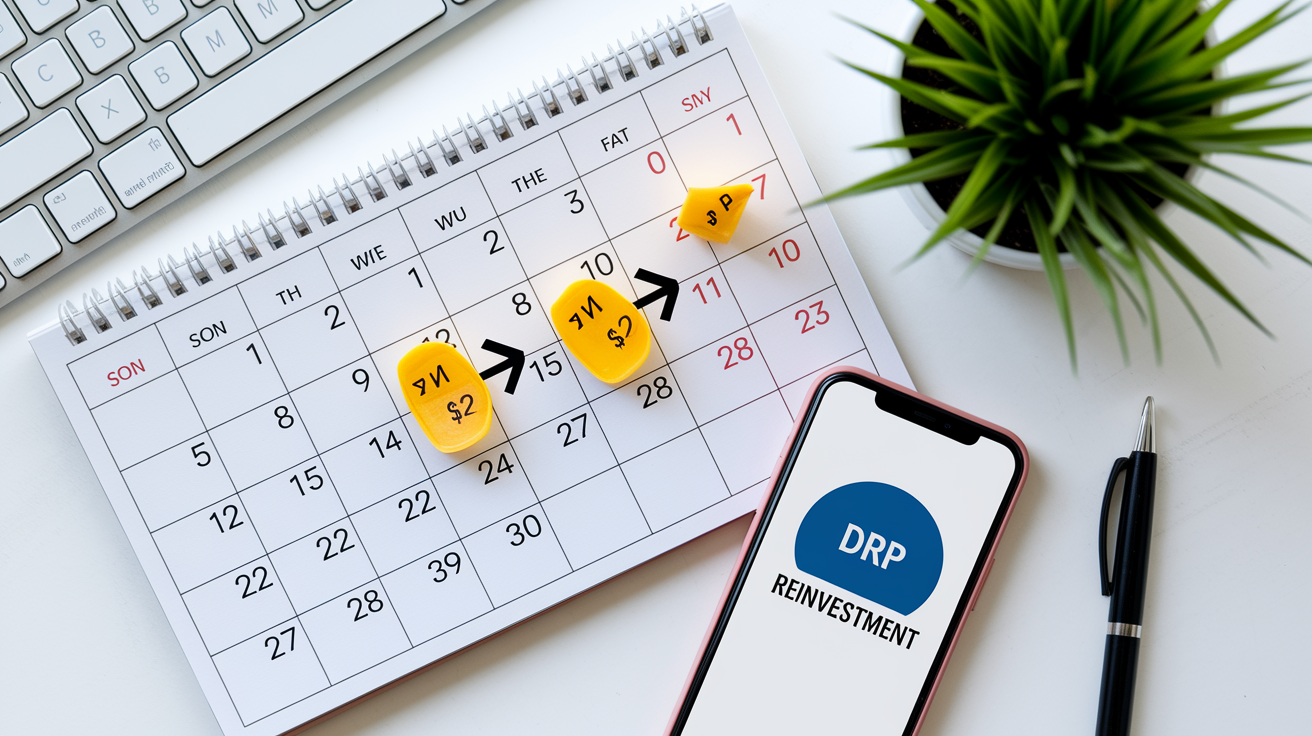
Most broad market ETFs pay quarterly distributions (dividends from the stocks they hold or interest from bonds). These distributions arrive as cash in your brokerage account around the same dates each year, often late in March, June, September, and December. You can use distribution timing to your advantage by scheduling your regular DCA contributions to coincide with distribution months. If your ETF typically pays distributions around the 25th of the month, consider scheduling your monthly BPAY transfer or automatic debit for the week after that date. When your scheduled contribution arrives, it combines with the cash distribution already sitting in your account, letting you make one larger trade instead of two smaller ones. Fewer trades mean lower cumulative brokerage fees and less time spent managing purchases.
The choice between receiving distributions as cash or enrolling in a dividend reinvestment plan (DRP) also affects your strategy. A DRP automatically uses distributions to buy additional units of the same ETF, often without charging brokerage. That automation is convenient and ensures every dollar is reinvested right away. The downside is that a DRP locks you into reinvesting in the same ETF regardless of whether that ETF has become overweight in your portfolio or whether another holding would better serve your rebalancing needs. Receiving distributions as cash gives you control. You can deploy that cash into underweight positions, add it to your next scheduled DCA contribution, or hold it temporarily if you’re planning a larger allocation shift.
Neither approach is universally better. The right choice depends on your portfolio complexity and rebalancing habits. If you hold a simple two or three ETF portfolio and you want zero maintenance, a DRP works well. If you’re managing a more nuanced allocation (say, splitting contributions among domestic equity, international equity, bonds, and real estate), taking distributions as cash lets you steer those dollars where they’re needed most each quarter.
Here’s a quick comparison of DRP versus cash distributions:
- Automatic reinvestment (DRP): Ensures immediate compounding, reduces decision fatigue, may avoid brokerage fees, but limits rebalancing flexibility.
- Cash distributions: Provides full control over where dividends are redeployed, supports rebalancing and tax loss harvesting, but requires manual action and may incur brokerage if you reinvest piecemeal.
- Hybrid approach: Use DRP for core holdings you plan to hold forever. Take cash for satellite or tactical positions where you want rebalancing control.
- Timing sync: Schedule your regular DCA contribution for the week after expected distribution dates to batch purchases and reduce total trades.
Tax Considerations for ETF Dollar Cost Averaging

ETF distributions (dividends, interest, and capital gains) are taxable in the year they’re paid, regardless of whether you reinvest them or take them as cash. This is a common point of confusion. Enrolling in a DRP doesn’t defer tax. You still owe tax on the distribution in the year it occurs. The tax character of the distribution depends on the underlying holdings. Dividends from domestic stocks may qualify for preferential tax treatment. Interest from bond ETFs is usually taxed as ordinary income. And capital gains distributions, which occur when the ETF’s manager sells securities at a profit, are taxed as capital gains. Your broker will send you annual tax statements summarizing distributions by type, making it easier to report them accurately.
Cost basis tracking becomes more complex with dollar cost averaging because you’re making multiple purchases at different prices throughout the year. Each purchase creates a separate tax lot with its own cost basis and purchase date. When you eventually sell units, your broker will apply a cost basis method (often average cost for ETFs, or first in first out by default) to determine your taxable gain or loss. Keeping detailed records of every trade, including the date, number of units, price per unit, and any fees paid, helps you verify your broker’s tax reports and optimize your tax outcome if you later switch cost basis methods. Most brokers provide downloadable transaction histories and annual consolidated tax statements, which simplify record keeping.
Another tax consideration is the wash sale rule. If you sell an ETF at a loss and repurchase the same or a substantially identical ETF within 30 days before or after the sale, the loss is disallowed for current year tax purposes and added to the cost basis of the new purchase. Frequent dollar cost averaging contributions can inadvertently trigger wash sales if you’re also selling positions to rebalance or harvest losses. To avoid this, either pause DCA contributions for 31 days around a loss harvesting trade, or use a different ETF that tracks a similar but not substantially identical index (for example, switching from one S&P 500 ETF to another total market ETF to break substantial identity).
Tax record essentials for DCA investors:
- Transaction log: Maintain a spreadsheet or use broker exports showing date, ETF ticker, units purchased, price per unit, and total cost including fees for every purchase.
- Distribution summaries: Download annual distribution statements showing ordinary dividends, qualified dividends, interest, and capital gains for each ETF.
- Cost basis elections: Confirm your broker’s default cost basis method (average cost or FIFO) and understand how it will calculate gains or losses when you sell.
Behavioural and Psychological Advantages of DCA for ETF Investors

Markets move, and emotions move with them. A 10 percent drop in two weeks can feel like a crisis. A 15 percent rally in a month can spark fear of missing out. Dollar cost averaging removes the need to make an investing decision in those moments. Your schedule is set. Your contribution amount is fixed. Whether the market is up or down, your system executes the same action: buy the same dollar amount of the same ETFs. This automation short circuits the emotional loop that leads to poor timing, buying at peaks out of excitement or selling at troughs out of fear.
The psychological benefit extends beyond simple automation. When prices fall, dollar cost averaging turns a negative headline into a mechanical advantage. Your fixed contribution buys more units. Instead of dreading a market dip, you can view it as a discount on the assets you’re accumulating. This reframing doesn’t eliminate the discomfort of seeing your account balance drop, but it shifts your focus from account value to unit accumulation. Over a 20 or 30 year investing horizon, the periods when you bought the most units at the lowest prices often become the foundation of long term wealth.
Behavioral pitfalls that dollar cost averaging helps you avoid:
- Market timing attempts: Trying to wait for the “perfect” entry point often results in missing the market entirely or buying only after a large run up.
- Paralysis from analysis: Constantly researching the next “right moment” to invest delays action and reduces time in the market.
- Panic selling: A disciplined DCA schedule keeps you buying during downturns, reinforcing the habit of adding to positions rather than fleeing them.
- FOMO buying: Automation prevents you from doubling contributions impulsively during rallies, which would break your plan and concentrate risk at high prices.
Example DCA Schedules, Contribution Amounts, and Planning Models
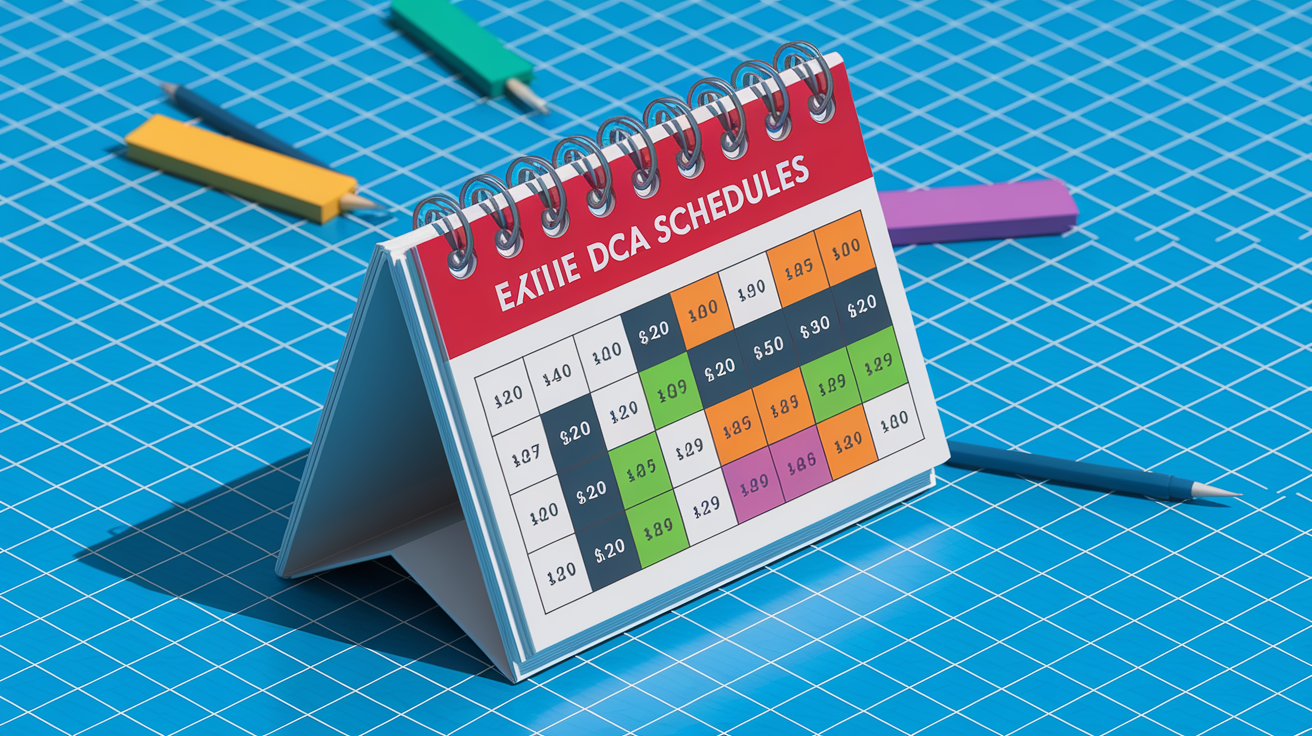
Choosing a contribution frequency and amount depends on your cash flow, discipline, and fee structure. Weekly contributions align well with paychecks and create the most frequent price averaging, but they also generate the most trades, potentially increasing fee drag if your broker charges per transaction. Monthly contributions match most salary cycles and simplify record keeping, making them the most common choice. Quarterly contributions reduce trading frequency and fees but leave cash sitting uninvested longer between purchases. The right schedule is the one you’ll stick to without exception.
Contribution amounts vary widely. A beginner might start with $50 or $100 per month to build the habit and test the process. An investor with a stable income and existing savings might commit $500 or $1,000 monthly. Some retirement focused investors allocate a fixed percentage of each paycheck (say, 10 or 15 percent), which scales contributions automatically as income rises. The key is consistency. A smaller amount invested every period usually outperforms a larger amount invested sporadically, because the smaller amount compounds over more periods and benefits from more price averaging opportunities.
Here’s a worked example using real world price movement. Imagine you invest $100 per month into an S&P 500 ETF starting in January 2023. In early January the ETF trades around $378. By mid year it has rallied to roughly $457. Your January $100 buys about 0.265 units at $378. By July your $100 buys about 0.219 units at $457. Over those seven months, your total investment is $700. The number of units you own reflects both the rising price trend and the automatic price averaging. You accumulated more units in the cheaper early months and fewer in the expensive later months. Your average cost per unit sits somewhere between $378 and $457, smoothing the impact of the mid year rally.
| Contribution Frequency | Example Amount | Pros | Trade Offs |
|---|---|---|---|
| Weekly | $25 per week ($100/month) | Maximum price averaging, aligns with weekly pay cycles, builds strong discipline | Highest number of trades increases fee impact; requires very low or zero commissions |
| Fortnightly | $50 every two weeks ($100/month) | Good price averaging, matches biweekly paychecks, moderate trade count | Slightly fewer averaging points than weekly; still requires low fee broker |
| Monthly | $100 to $1,000 per month | Simple to track, matches salary deposits, balances trade frequency and fees | Less frequent price averaging than weekly or fortnightly schedules |
| Quarterly | $300 to $3,000 per quarter | Lowest trade count reduces fees, can sync with ETF distribution months | Cash sits uninvested longer; fewer price averaging opportunities |
Final Words
You set a fixed dollar amount and schedule regular ETF purchases to smooth out price swings. The guide ran through the DCA math, how to automate contributions, and simple worked examples.
We covered choosing low-cost, liquid ETFs, watching fees and tax records, and timing distributions or using dividend reinvestment. DCA also lowers emotional timing mistakes and keeps you disciplined.
If you want a repeatable way to build exposure over time, dollar cost averaging into etfs is a practical, long-term-friendly approach. Stay consistent.
FAQ
Q: Is dollar-cost averaging good for ETFs? Can you dollar-cost average an ETF?
A: Dollar-cost averaging is a good approach for ETFs and yes, you can DCA into an ETF by investing fixed amounts regularly; it smooths volatility, reduces timing risk, and limits emotional trading.
Q: What is the 3:5-10 rule for ETFs?
A: The 3:5-10 rule for ETFs is a guideline suggesting three core broad-market funds, expanding to five to ten total ETFs with satellites, balancing simplicity with enough diversification across major assets.
Q: What is the 4% rule for ETF?
A: The 4% rule for ETFs is a retirement withdrawal guideline: withdraw 4 percent of your portfolio in year one, then adjust for inflation; it’s a rough sustainability benchmark, not a guarantee.