

What if you could chase extra returns without turning your whole portfolio into a speculation?
Core‑satellite does exactly that: a low‑cost, broadly diversified core anchors your wealth while smaller, higher‑conviction satellites hunt for extra gains.
It matters because you control fees, keep broad diversification, and isolate active risk so one bad bet won’t derail your plan.
This post shows how to set core weights, pick disciplined satellites, and manage fees, sizing, and rebalancing so the approach builds balanced wealth.
Understanding the Core‑Satellite Strategy

Core‑satellite is a portfolio management approach that pairs a low‑cost, broadly diversified “core” holding with smaller, higher‑conviction “satellite” positions. The core captures market returns through passive index funds or ETFs tracking large benchmarks. Satellites include active managers, sector bets, thematic exposures, or alternative assets designed to seek additional performance.
Why build this way? You get simplicity and opportunity. The core provides stability and cost efficiency, broad market exposure at expense ratios often below 0.20%. Satellites offer targeted exposure to ideas you believe will outperform. This separation lets you keep most assets in low‑turnover, tax‑efficient vehicles while concentrating active decisions and higher fees in a controlled sleeve.
The mechanics are straightforward. Build a diversified foundation using total‑market equity and bond index funds, then layer on satellites that reflect specific views or opportunities. The core anchors the portfolio during volatility. The satellites add flexibility and potential alpha. Rebalancing periodically keeps the mix aligned with your target allocation and prevents drift.
Core Allocation Structure

Core holdings typically consist of broad‑market index funds and ETFs that provide exposure to equities, fixed income, and sometimes real assets. Common examples: total US stock market funds, international equity funds (developed and emerging markets combined or separate), and aggregate bond index funds. These instruments deliver diversification across thousands of securities, minimal tracking error to their benchmarks, and very low expense ratios, often 0.03% to 0.20%.
The core weight usually ranges from 60% to 80% of the total portfolio, depending on risk tolerance and investment goals. Conservative investors may push the core to 80% or even 90%, relying on stability and predictable returns. Aggressive investors comfortable with higher volatility and active risk may dial the core down to 60%. That leaves more room for satellite bets. The core is designed to require minimal attention: low turnover, infrequent rebalancing, and straightforward tax reporting.
Typical core components include total market equity index funds (US or global), international developed‑market equity index funds, aggregate bond index funds (investment‑grade, government and corporate), and short‑term or intermediate‑term bond funds for lower‑risk profiles.
Satellite Allocation Options

Satellite positions are higher‑conviction allocations chosen to enhance returns, tilt exposure toward specific factors or themes, or hedge portfolio risks. These can include actively managed mutual funds or ETFs, sector funds (technology, healthcare, financials), factor strategies (value, momentum, quality, small‑cap), thematic ETFs (clean energy, robotics, cybersecurity), emerging and frontier market equities, commodities, real estate investment trusts, high‑yield bonds, or alternative assets like gold and inflation‑linked bonds.
Satellites typically represent 20% to 40% of the portfolio. The exact weight depends on how much active risk and fee drag you’re willing to accept in exchange for potential outperformance. Each satellite should have a clear thesis. Why do you expect it to add value? And a position‑size limit, often capped at 5% to 10% per holding to prevent overconcentration. Satellites introduce higher turnover, higher expense ratios (commonly 0.50% to 1.50% or more), and greater tracking error, so disciplined sizing and periodic review are essential.
Common satellite categories include sector and thematic ETFs targeting specific industries or trends, factor‑tilt funds emphasizing value, momentum, quality, or small‑cap exposure, active equity or bond managers with strong track records, emerging and frontier market funds for higher‑growth potential, and alternative assets such as commodities, REITs, gold, or inflation‑protected securities.
Benefits of the Core‑Satellite Approach

Cost control is a primary advantage. By keeping the majority of assets in low‑fee index funds, you minimize the drag of management fees and transaction costs. The core expense ratio might average 0.10%. Satellites, though more expensive, represent a smaller share of the portfolio, so blended fees remain moderate. This structure lets you pursue active strategies without paying active‑management fees on every dollar.
Diversification improves because the core provides stable, broad market exposure while satellites add uncorrelated or targeted risks. When one satellite underperforms, the core and other satellites can offset losses. This separation also clarifies performance attribution. You can measure whether satellites justify their higher fees by comparing their returns to the core benchmark.
Flexibility is the third benefit. You can adjust satellite positions as market conditions or personal views change without dismantling the entire portfolio. If a thematic bet plays out or a sector becomes overvalued, you trim or exit that satellite while the core remains untouched. This modularity supports long‑term discipline. The core stays consistent, and only satellites reflect tactical decisions.
Risks and Considerations

Satellites increase portfolio complexity and volatility. Active funds and concentrated sector bets can deviate significantly from broad benchmarks, introducing tracking error and drawdown risk. If satellites underperform, the portfolio may lag a simple all‑index approach, and higher fees compound the shortfall. Satellites also require ongoing monitoring to ensure theses remain valid and performance justifies the allocation.
Overconcentration is a common mistake. Allocating too much to a single satellite, say 15% or 20%, magnifies idiosyncratic risk and can cause sharp swings in total portfolio value. Emotional trading is another pitfall. Investors may chase recent winners or panic‑sell underperformers, eroding returns through poor timing and unnecessary transaction costs.
Major pitfalls include excessive satellite weight beyond 40% of the portfolio, diluting the stability benefit of the core. Ignoring fee impact matters too. Satellites charging 1%+ must generate material alpha to break even after costs. And frequent rebalancing without discipline leads to tax events, trading costs, and performance drag.
Example Portfolio Models
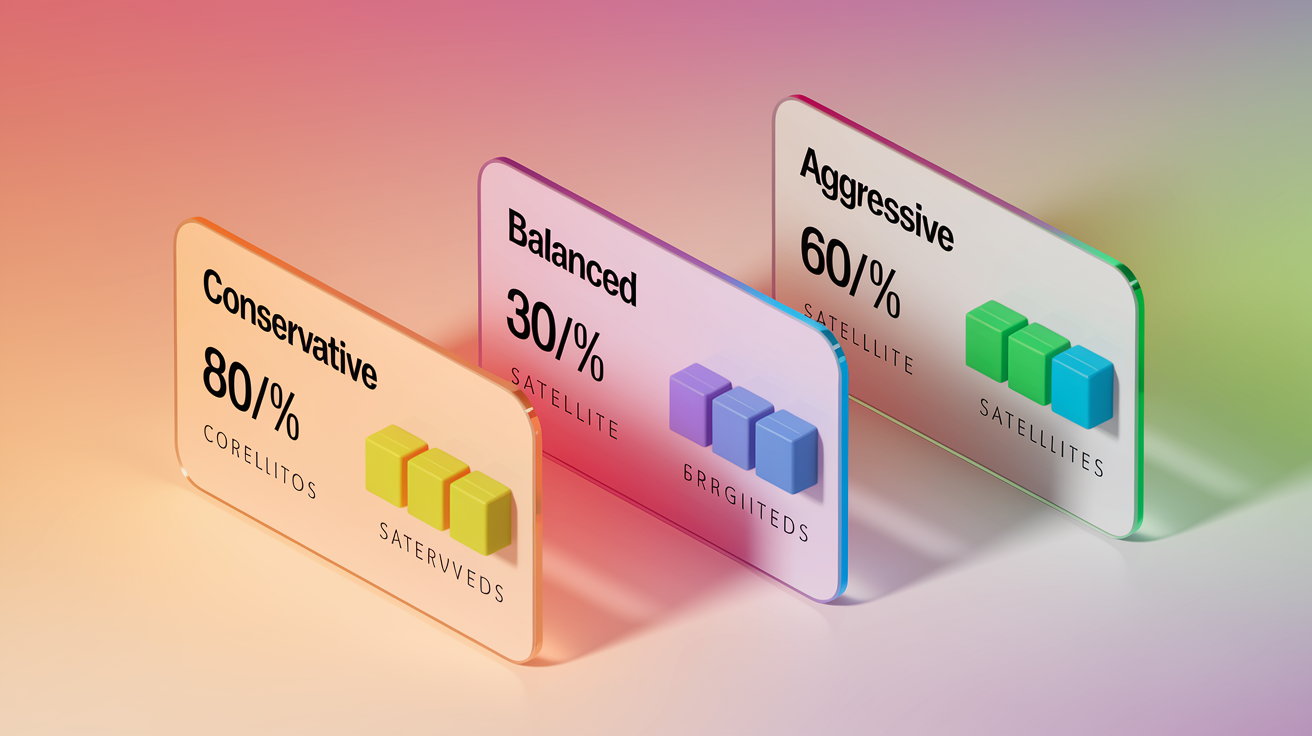
Allocation models vary by risk tolerance and return objectives. Conservative investors favor a larger core to limit volatility. Aggressive investors accept higher satellite exposure for potential outperformance. Each model specifies target percentages and example satellite choices, providing a starting template that you customize based on personal views and market conditions.
The table below shows three common profiles. Conservative allocations emphasize stability and income, balanced profiles mix growth and income, and aggressive profiles tilt toward equity and alternative risk. Satellite choices reflect typical preferences. Dividend funds and inflation protection for conservative investors, sector and factor tilts for balanced, and higher‑risk themes and alternatives for aggressive.
| Profile | Core % | Satellite % | Example Satellite Choices |
|---|---|---|---|
| Conservative | 80% | 20% | Dividend equity fund, inflation‑linked bond ETF, short‑duration credit |
| Balanced | 70% | 30% | Emerging markets ETF, value factor fund, sector theme (tech or healthcare) |
| Aggressive | 60% | 40% | Small‑cap growth, commodities ETC, high‑yield bonds, thematic innovation fund |
Implementing the Strategy Step‑by‑Step

Building a core‑satellite portfolio requires clear sequencing. Define objectives, construct the core, add satellites with discipline, and establish maintenance rules. Following these steps ensures the portfolio reflects your goals and risk tolerance while avoiding common setup errors like overallocation or unclear satellite theses.
Start by assessing risk tolerance and time horizon. Clarify whether you prioritize stability, growth, or income, and set a realistic investment period, typically five to ten years or longer. Then set the core‑satellite split. Choose a target ratio based on your comfort with active risk and fee tolerance. Common examples: 70/30, 80/20, 60/40.
Next, select core holdings. Pick low‑cost, broad‑market index funds or ETFs for equities and bonds. Examples: a total world stock ETF and a global aggregate bond fund. Then choose satellite exposures. Identify two to five satellites with clear theses and set position‑size caps, typically 5% to 10% per satellite.
Decide rebalancing rules. Establish a calendar schedule (quarterly, semi‑annual, or annual) or threshold bands (rebalance when allocations drift by 5% or more from target). Finally, implement tax placement. Hold high‑turnover or income‑generating satellites in tax‑advantaged accounts (IRAs, 401(k)s) and keep tax‑efficient core funds in taxable accounts when possible.
Rebalancing and Ongoing Maintenance

Rebalancing realigns your portfolio to target weights, controlling drift caused by differential returns. Calendar‑based rebalancing, quarterly, semi‑annual, or annual, provides discipline and simplicity, though it may trigger unnecessary trades if allocations remain close to target. Threshold rebalancing waits until an asset class drifts a set percentage (commonly 5% or 10%) from its target before acting, reducing trading frequency and transaction costs.
Satellites often require more frequent attention than the core because higher volatility and active management can cause faster drift. Review satellite performance and theses at least annually to confirm each position still adds value or diversifies effectively. Use new contributions to rebalance toward target allocations rather than selling winners. This approach minimizes taxable events and trading costs.
Popular rebalancing methods include calendar rebalancing (quarterly or annual), trading on a fixed schedule regardless of drift size. Threshold rebalancing (±5% or ±10% bands), trading only when an allocation moves materially off target. Contribution‑driven rebalancing, directing new cash to underweight positions to restore balance. And tax‑loss harvesting. At year‑end, sell underwater positions to realize losses, then reinvest in similar (but not identical) holdings to maintain exposure while capturing tax benefits.
How the Strategy Compares to Other Portfolio Methods

Core‑satellite sits between pure passive indexing and full active management. Pure passive investors hold only broad‑market index funds, accepting market returns with minimal cost and no attempt at outperformance. Core‑satellite preserves the low‑fee foundation but adds targeted active bets, introducing modest complexity and fee drag in exchange for potential alpha. The trade‑off? Slightly higher costs and monitoring burden versus the opportunity for satellites to beat benchmarks.
Fully active portfolios allocate most or all assets to active managers, paying higher fees across the board and accepting greater tracking error. Core‑satellite reduces overall active exposure and fee drag by concentrating active decisions in a smaller sleeve, limiting downside if those bets fail. Factor‑tilt strategies systematically overweight specific factors (value, momentum, size) across the entire portfolio. Core‑satellite allows factor exposure in satellites while keeping the core neutral, offering more flexibility to adjust tilts over time.
Tactical asset allocation frequently shifts weights among asset classes based on market‑timing views, often with high turnover and short holding periods. Core‑satellite is a strategic structure with periodic rebalancing and longer‑term satellite theses, not a market‑timing framework. The core remains stable. Satellites reflect conviction ideas held for months or years, not weeks.
| Strategy | Key Trait | Difference vs Core‑Satellite |
|---|---|---|
| 100% Passive Indexing | Lowest cost, pure market exposure | No active positions; core‑satellite adds satellites for potential outperformance at slightly higher cost |
| Full Active Management | Entire portfolio managed actively | Higher fees and tracking error across all assets; core‑satellite limits active risk and fees to satellite sleeve |
| Tactical Asset Allocation | Frequent shifts based on market timing | High turnover and short‑term bets; core‑satellite is strategic with longer‑term satellite theses and stable core |
Final Words
We walked through the core-satellite idea: a broad, low-cost core plus smaller, tactical satellites, what typically fills each sleeve, and how allocations shift by risk profile.
We covered practical steps, like choosing funds, setting allocations, rebalancing rules, and the main trade-offs: lower cost and diversification versus satellite volatility and overconcentration risk.
With the core satellite portfolio strategy explained, you have a simple framework to balance stability and opportunity. Start small, set clear rules, and check in regularly—your portfolio will be steadier for it.
FAQ
Q: What is the core‑satellite strategy?
A: The core‑satellite strategy is a portfolio approach that pairs a broad, low‑cost core of index funds with smaller, targeted satellite positions to balance stability and potential outperformance.
Q: Why do investors choose a core‑satellite structure?
A: Investors choose a core‑satellite structure because it combines diversification and low cost from the core with tactical flexibility from satellites, helping manage risk while pursuing extra return opportunities.
Q: How large should the core allocation be?
A: The core allocation should be sized to your risk tolerance; typical ranges are 60%–90% of the portfolio, with more conservative investors toward the high end and aggressive ones lower.
Q: What typically goes into the core of the portfolio?
A: The core typically includes broad index funds or ETFs like total US market, S&P 500, international equity, and aggregate bond funds to provide stability, diversification, and low fees.
Q: What kinds of investments are used as satellites?
A: Satellite investments can be sector ETFs, thematic funds, factor strategies, active managers, or regional bets—usually representing roughly 10%–40% of the portfolio to add targeted exposure.
Q: How do I implement a core‑satellite portfolio step‑by‑step?
A: To implement a core‑satellite portfolio, pick a core allocation, define satellite goals, choose specific funds, set target weights, execute trades, and monitor and rebalance periodically.
Q: How often should I rebalance a core‑satellite portfolio?
A: Rebalance a core‑satellite portfolio on a regular schedule (quarterly or annually) or when allocations deviate by thresholds (commonly about 5%); satellites may need more frequent reviews.
Q: What are the main risks of using a core‑satellite approach?
A: The main risks are increased volatility from satellites, overconcentration in themes or sectors, tracking error versus benchmarks, and emotionally driven trading that undermines the plan.
Q: How does core‑satellite compare with pure passive or fully active strategies?
A: Core‑satellite adds tactical exposure while keeping costs lower than full active management; compared with pure passive, it allows targeted tilts without rebuilding the whole portfolio.
Q: What are common example allocation models for different investors?
A: Common models include 80/20 (core/satellite) for conservative investors and 60/40 for more aggressive ones; satellites might include tech ETFs, value factors, or emerging‑markets exposure.
Q: Who is the core‑satellite strategy best suited for?
A: The core‑satellite strategy suits investors who want a simple, diversified base yet still want to pursue targeted opportunities—appropriate for DIY investors and advisor‑led portfolios with a long horizon.
Q: What cost and tax factors should I consider with core‑satellite investing?
A: Consider low‑cost index funds for the core to limit fees, and manage satellite turnover to control taxes; use tax‑efficient placement when possible and watch trading costs for active satellites.