

Think earnings reports are only for pros?
Think again — most individual investors ignore the numbers that actually drive stock moves.
This post shows how to read a report step by step, focusing on growth, profitability, and cash.
You’ll learn to spot when a beat is real versus when it’s just accounting, translate guidance into portfolio moves, and flag balance sheet risks before prices react.
By the end you’ll have a simple checklist to cut through noise and make clearer, repeatable decisions.
Core Components of an Earnings Report

An earnings report is a quarterly financial document companies release to show how much money they made, spent, and what profit (or loss) they generated over the previous three months. Public companies file these reports with regulators and publish them on investor relations pages. Each report covers a defined period, usually one quarter, and includes standardized financial statements, management commentary, and forward guidance. Think of it as the company’s report card. A clear snapshot of operational health and financial progress.
Earnings reports matter because they answer three questions investors need to make informed decisions: did the company grow or shrink, was it profitable, and what does management expect next. The stock market reacts to these answers, often sharply, because they reveal whether a company is meeting expectations, gaining competitive ground, or facing headwinds. Even strong absolute numbers can trigger a price drop if investors were expecting stronger results. Earnings reports turn abstract business strategies into concrete numbers and trends you can evaluate.
Every earnings report includes several core components that tell the full financial story. The income statement shows revenue (top line), expenses, and net income (bottom line). The balance sheet lists what the company owns (assets) and owes (liabilities), along with shareholder equity. The cash flow statement tracks real cash moving in and out of the business across operations, investing, and financing. The earnings release typically includes earnings per share (EPS), which measures profit per outstanding share, and management guidance, which forecasts future performance. Together, these pieces give you a detailed view of profitability, financial stability, and outlook.
Understanding the Income Statement
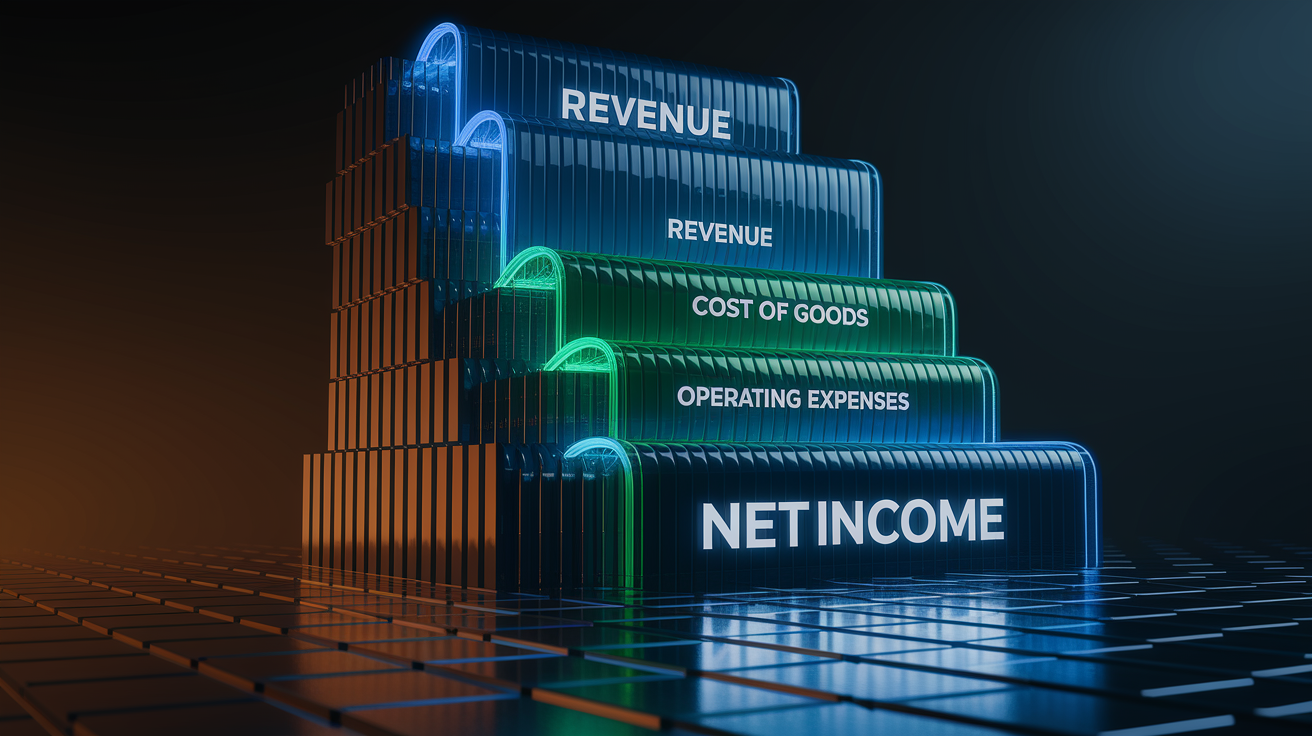
The income statement starts with revenue. Often called the top line, it represents all the money the company brought in during the quarter from selling products or services. Revenue growth is one of the first signals investors look for. Companies that consistently grow revenue are expanding their market reach or raising prices. Revenue can be broken down by business segment or geography, which helps you see where growth is concentrated or slowing. For example, a software company might report cloud subscription revenue separately from legacy license sales, revealing which part of the business is driving future growth.
After revenue comes cost of revenue, which includes direct costs like materials and manufacturing. Subtracting cost of revenue from revenue gives you gross profit, and dividing gross profit by revenue gives you gross margin. A percentage that shows how much profit the company keeps after covering direct costs. Below gross profit, the income statement lists operating expenses: research and development, marketing, sales, and general administration. These expenses reveal how much the company’s investing in growth and infrastructure. Subtracting operating expenses from gross profit gives you operating income and operating margin, which measure profitability from core business operations before interest and taxes.
At the bottom of the income statement is net income. The profit left after all expenses, interest, taxes, and one-time items. Net income is the earnings figure used to calculate EPS. Rising net income over multiple quarters signals improving profitability. Falling net income, even with revenue growth, can mean rising costs or margin pressure. Always compare net income quarter over quarter (QoQ) and year over year (YoY) to spot trends. A single strong quarter is useful, but consistent improvement over four to eight quarters is a better indicator of sustainable performance.
Revenue growth (YoY and QoQ): Measures top line expansion and market demand.
Gross margin: Shows pricing power and cost control on direct production.
Operating margin: Reflects efficiency after accounting for all operating expenses.
Net income trend: Indicates bottom line profitability and earnings quality over time.
Understanding the Balance Sheet

The balance sheet lists everything the company owns, divided into current assets (cash, accounts receivable, inventory) and long term assets (property, equipment, intellectual property). Cash is the most liquid and flexible asset. It funds operations, acquisitions, and shareholder returns. Accounts receivable represents money owed to the company by customers. Rising receivables can indicate strong sales, but if they grow faster than revenue, it may signal collection problems. Inventory levels reveal how efficiently the company manages stock. Excess inventory can become obsolete, while too little can mean missed sales.
Liabilities include everything the company owes, split into current liabilities (due within a year, like accounts payable and short term debt) and long term liabilities (bonds, loans, pension obligations). Debt is a key focus for investors because it creates fixed interest obligations and financial risk. Compare total debt to total equity to gauge leverage. A Debt to Equity ratio above 1.0 means the company owes more than it owns outright. Rising debt without corresponding revenue growth can signal trouble. Also check interest coverage (operating income divided by interest expense) to see if the company can comfortably service its debt.
Shareholder equity represents the net value left for owners after subtracting liabilities from assets. A growing equity base indicates retained earnings and financial stability. A shrinking equity base can result from losses, heavy dividends, or aggressive buybacks without sufficient earnings. Strong balance sheets have ample cash, manageable debt, and stable or growing equity. Weak balance sheets show high leverage, declining cash reserves, and rising short term liabilities. When evaluating a stock, compare the balance sheet to competitors and look for trends. Improving liquidity and falling debt are positive signals.
Understanding the Cash Flow Statement

The cash flow statement is divided into three sections: operating activities, investing activities, and financing activities. Operating cash flow (OCF) shows cash generated from core business operations. Selling products, collecting receivables, paying suppliers. Positive and growing OCF is necessary because it confirms that the company can fund itself without relying on external financing. If net income is rising but OCF is flat or negative, it may indicate accounting profits that aren’t backed by real cash, often due to rising receivables or inventory.
Investing activities include capital expenditures (CAPEX) on equipment, facilities, and technology, as well as acquisitions and asset sales. CAPEX is necessary for growth, but excessive CAPEX relative to revenue can strain cash reserves. Free cash flow (FCF) is calculated as operating cash flow minus capital expenditures. It represents cash available for dividends, buybacks, debt repayment, or reinvestment. Rising FCF signals financial flexibility and shareholder friendly potential. Declining FCF can mean heavy reinvestment or deteriorating operations.
Financing activities track cash from issuing or repaying debt, issuing or buying back stock, and paying dividends. Companies that consistently pay dividends or buy back shares typically have strong cash generation. Frequent equity issuance can dilute existing shareholders. Rising debt issuance without corresponding growth in revenue or assets can be a warning sign. Together, the three cash flow sections reveal whether the company is self sustaining, capital hungry, or over leveraged.
Operating cash flow: Cash from core business. Should be positive and growing.
Investing cash flow: CAPEX and acquisitions. Negative is normal, but watch the size relative to OCF.
Financing cash flow: Dividends, buybacks, and debt activity. Reveals capital allocation priorities.
Key Metrics Investors Should Focus On

Earnings per share (EPS) is the most closely watched number in any earnings report. It equals net income divided by the number of outstanding shares, and it allows you to compare profitability across companies of different sizes or track a single company’s profit growth over time. Reported EPS includes all income and expenses, while adjusted EPS excludes one time items like restructuring charges or legal settlements. Markets often focus on adjusted EPS, but if adjustments are frequent or growing, they may mask underlying problems. Compare reported EPS to analyst estimates. A beat (above expectations) often lifts the stock, while a miss can trigger selling even if the absolute number looks strong.
Revenue growth tells you whether the company’s expanding its market or losing ground. Look at both year over year (YoY) and quarter over quarter (QoQ) growth rates. Consistent double digit YoY growth signals a healthy, expanding business. Slowing growth or shrinking revenue can indicate market saturation, competitive pressure, or weak demand. Revenue growth alone isn’t enough. Check whether growth is accompanied by rising margins or falling margins, which would suggest the company’s sacrificing profitability to chase volume.
Margin trends reveal operational efficiency and pricing power. Gross margin shows how much profit remains after direct production costs. Rising gross margin means better pricing or cost control, while falling gross margin signals pricing pressure or rising input costs. Operating margin accounts for all operating expenses and reflects core business profitability. Net margin is the final profit after all costs, interest, and taxes. Track these margins over multiple quarters. Improving margins indicate operating leverage and competitive strength, while deteriorating margins are often early warning signs of trouble.
Management guidance is often more important to stock prices than historical results because it sets expectations for future quarters. Guidance can include revenue ranges, EPS targets, margin outlooks, and commentary on market conditions or strategic priorities. Upward revisions to guidance signal confidence and often drive immediate buying. Downward revisions or cautious language can weigh heavily on the stock even if past results were solid. Pay attention to the tone in guidance. Specific, confident forecasts are reassuring. Vague or hedged statements can indicate uncertainty or hidden risks.
Comparing Results to Analyst Expectations

Before each earnings release, Wall Street analysts publish consensus estimates for revenue and EPS based on their models and company guidance. These estimates become the benchmark that markets use to judge results. A company can report strong absolute growth, say 15 percent revenue growth and record profits, yet see its stock fall if analysts were expecting 20 percent growth. The surprise (actual result minus estimate) drives the immediate market reaction more than the raw numbers. Analysts also forecast guidance, so a guidance miss can be just as damaging as an earnings miss.
Earnings surprises come in three flavors: beat (results exceed estimates), meet (results match estimates), and miss (results fall short). A beat often triggers buying, especially if paired with raised guidance, because it signals stronger than expected demand or execution. A meet can be neutral or slightly positive if guidance is solid. A miss typically triggers selling and can lead analysts to downgrade ratings and lower price targets. The magnitude of the surprise matters. A small beat may not move the stock much, while a large beat can drive significant upside. Conversely, a modest miss might be forgiven if guidance is strong, but a large miss with weak guidance can cause sharp declines.
Beat: Results above consensus. Usually positive for stock price, especially with strong guidance.
Meet: Results in line with estimates. Reaction depends on guidance and market sentiment.
Miss: Results below expectations. Often negative, particularly if guidance is cut or cautious.
Identifying Red Flags in Earnings Reports

Declining or stagnant margins are one of the clearest warning signs in an earnings report. If gross margin is shrinking, the company may be facing pricing pressure from competitors or rising input costs it can’t pass along. If operating margin is falling, operating expenses are growing faster than revenue, which can indicate inefficiency, heavy spending without payoff, or competitive threats. Consistently falling net margin suggests the company’s losing profitability despite revenue growth. Compare margin trends to competitors. If peers are maintaining or expanding margins while this company isn’t, it’s a red flag.
Weak or negative operating cash flow, especially when paired with rising net income, indicates that reported earnings may not reflect real cash generation. This disconnect often stems from aggressive revenue recognition, rising accounts receivable (customers not paying), or inventory buildup (unsold goods). Free cash flow that turns negative or declines sharply signals that the company’s burning cash and may need to raise debt or equity to stay afloat. Always cross check net income with operating cash flow and free cash flow. Strong earnings should be supported by strong cash flow.
Rising debt levels without corresponding revenue or cash flow growth can signal financial distress or over leverage. Check the Debt to Equity ratio and interest coverage ratio (operating income divided by interest expense). If Debt to Equity is climbing and interest coverage is falling below 2 or 3, the company may struggle to service its debt if business slows. Repeated one time charges or adjusted earnings that exclude recurring costs are another red flag. If the company constantly adjusts out restructuring, legal settlements, or impairments, those costs may be part of normal operations, not true one offs.
Management tone and guidance cuts matter as much as numbers. If management sounds cautious, vague, or evasive during the earnings call, or if they cut guidance without a clear external reason, it often indicates problems they’re not yet disclosing fully. Also watch for frequent management turnover, especially at the CFO level, which can signal internal disagreements or accounting concerns. Red flags rarely appear in isolation. When you see multiple warning signs (falling margins, weak cash flow, rising debt, and cautious guidance), it’s time to reassess the investment thesis and consider reducing or exiting the position.
Deteriorating margins: Pricing pressure or rising costs eroding profitability.
Weak operating cash flow: Earnings not backed by real cash generation.
Rising debt and falling interest coverage: Financial leverage becoming unsustainable.
Repeated adjusted earnings exclusions: One time charges that aren’t truly one time.
Practical Walkthrough Using a Sample Earnings Report

Imagine a hypothetical company, TechFlow Inc., just released Q3 earnings. The press release headline shows revenue of $500 million (up 12 percent YoY), net income of $50 million, and EPS of $1.00. Analyst consensus was $480 million revenue and $0.95 EPS, so TechFlow beat on both lines. Management guided Q4 revenue to $520–$530 million, which is above the $510 million consensus. At first glance, this looks like a strong report. Revenue growth, an earnings beat, and raised guidance. Now let’s walk through the details to confirm.
Start by opening the full income statement and checking revenue by segment. TechFlow breaks out software subscriptions ($350 million, up 18 percent YoY) and hardware sales ($150 million, flat YoY). The growth is concentrated in subscriptions, which is positive because recurring revenue is more stable and valuable. Next, check the margins. Gross margin is 65 percent, up from 63 percent last quarter, indicating pricing power or cost efficiency. Operating margin is 15 percent, up from 14 percent, showing operating leverage. Net margin is 10 percent, steady with prior quarters. These margin trends are healthy. Revenue growth is translating into profit growth without margin pressure.
Review headline numbers: Revenue $500M (beat), EPS $1.00 (beat), Q4 guidance $520–$530M (raised).
Analyze revenue by segment: Subscriptions growing 18 percent, hardware flat. Growth is in the right place.
Check margins: Gross margin 65 percent (up), operating margin 15 percent (up), net margin 10 percent (stable). All positive trends.
Examine cash flow: Operating cash flow $60M (up from $55M last quarter), CAPEX $10M, free cash flow $50M. Strong and growing.
Read guidance and tone: Management raised Q4 outlook and sounded confident about new product pipeline. No red flags in commentary.
Final Words
In the action, we walked through what an earnings report contains: income statement, balance sheet, cash flows, and why each piece matters for judging profit and cash.
We covered the key metrics—EPS, revenue growth, margins, guidance—how to compare results to expectations, and the red flags to watch. The practical walkthrough ties those ideas into a clear step‑by‑step approach.
Use this framework when learning how to read earnings report for stocks: start with revenue and cash flow, check margins and guidance, then flag risks. You’ll feel more confident.
FAQ
Q: How to read a stock earning report?
A: The best way to read a stock earnings report is to focus first on revenue, EPS and guidance, then check margins, cash flow, balance sheet items, and compare results to analyst expectations and management comments.
Q: Do stocks usually go up or down after an earnings report?
A: Stocks usually move up or down after an earnings report depending on whether results beat, meet, or miss expectations; forward guidance, macro context, and investor sentiment also shape the direction.
Q: What does 20x earnings mean?
A: Twenty times earnings means the stock’s price equals 20 times its annual earnings per share, the price-to-earnings (P/E) ratio, implying investors pay the equivalent of 20 years of current earnings.
Q: What is a good PE and EPS?
A: A good P/E and EPS depend on sector and growth: a reasonable P/E is low versus peers or justified by faster growth (value ~10–15, growth 20+), while EPS should show steady year-over-year increases.