

What if a single press release could create a short-term trading edge you can measure?
Merger announcements do exactly that: the target often jumps toward the offer, the acquirer can dip, and a clear spread appears to trade.
This piece shows what drives those moves, why the spread exists, and the practical milestones that narrow or widen it, including shareholder votes, regulatory reviews and financing updates.
Along the way you’ll get simple positioning ideas, risk reminders, and a short checklist for watching deals from announcement to close.
How Merger Announcements Act as Immediate Stock Catalysts and What Investors Should Expect

A merger announcement turns a company’s stock into an event-driven trade the second the news hits. The target’s price typically jumps toward the offer, sometimes in minutes, while the acquirer’s shares often drop as the market digests dilution, integration headaches, or the premium being paid. What’s left is a gap between where the target trades and what the deal values it at. That spread sticks around until closing. Traders buy the target at a discount to the deal price, betting the merger goes through and the gap closes. In stock-for-stock deals, arbitrageurs short the acquirer at the same time, matching the exchange ratio to lock in the spread and hedge market swings. Cash deals are simpler: buy the target, wait for the cash at closing.
Spreads on announced deals usually run 3 percent to 7 percent, reflecting time value, execution risk, and the chance things fall apart. Historically, 70 percent to 90 percent of announced U.S. mergers close, and the average timeline is three to four months. Managers who spread positions across multiple deals and use modest leverage (think 1.2× to 5× net asset value depending on approach and structure) can generate annualized returns around 7 percent to 12 percent. These returns don’t move much with the broader market because they depend on deal progress, not equity direction. Capital recycling speeds up compounding. When a deal closes in three months, you roll that capital into the next one. Four cycles per year.
Failure hurts. When a deal breaks (financing collapses, regulators say no, due diligence uncovers problems, or the board walks away), the target’s stock typically drops 20 percent to 40 percent from the post-announcement price. The takeover premium evaporates and investors reassess what the company’s actually worth standalone. The risk looks like selling insurance: small, steady premiums most of the time, then occasional big losses. You need to understand that asymmetry before putting on any merger-arb position.
Key milestones that move spreads:
Shareholder vote announcement – The target’s board sets a record date and meeting schedule. Spreads often tighten because the path to approval becomes clear.
Initial acceptance or tender threshold – In tender offers, the bidder discloses early acceptance levels, which signals momentum and cuts uncertainty.
Regulatory filing confirmations – Hart-Scott-Rodino or cross-border antitrust submissions start countdown clocks and clarify approval timelines.
Competing bid or white-knight rumors – A second interested party can push the target’s price above the original offer and widen spreads temporarily.
Financing verification or bridge-loan commitment – Confirmation that the acquirer has debt or equity financing locked down removes one failure risk and narrows spreads.
Event-driven Strategies: Merger Arbitrage
Key Types of Merger Transactions and Their Stock‑Price Implications
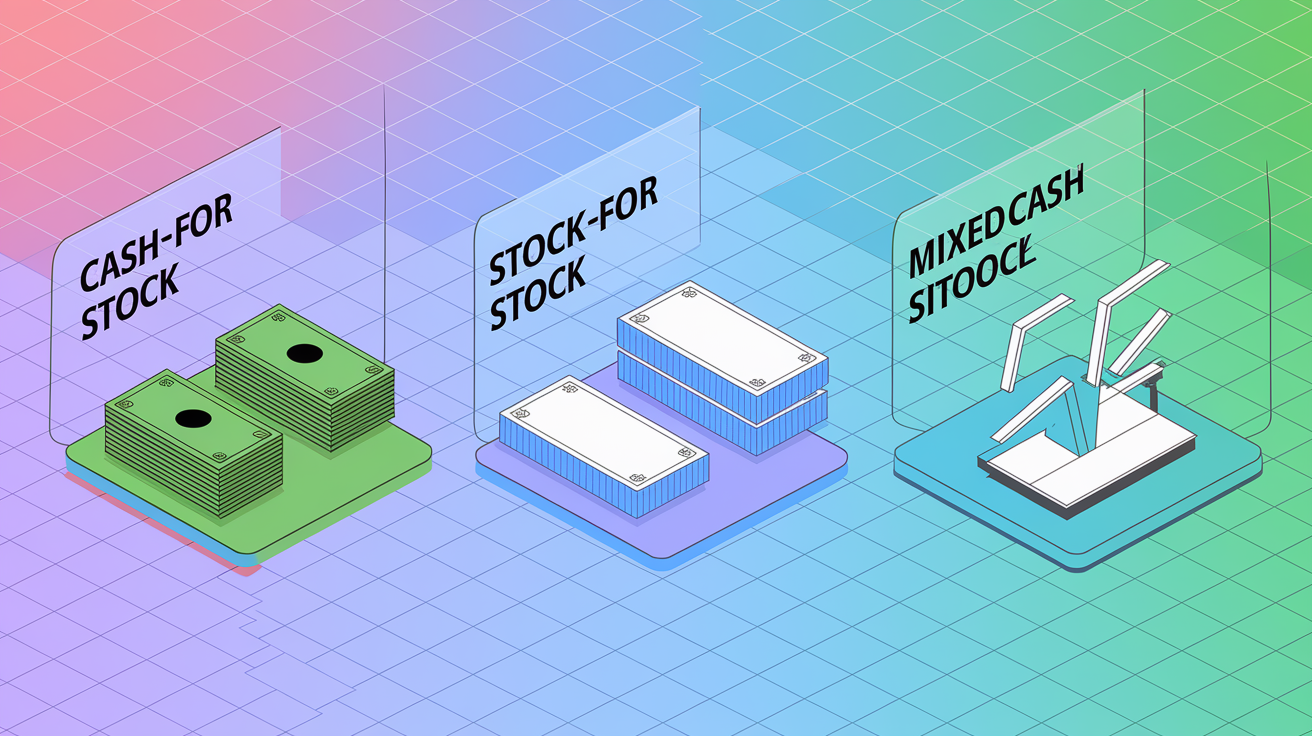
Cash-for-stock deals are straightforward. The bidder commits a fixed dollar amount per target share, and arbitrageurs buy the target and hold until the cash shows up at closing. Stock-for-stock deals add a variable: the exchange ratio, which defines how many acquirer shares the target holder receives. Because the acquirer’s stock can move between announcement and close, the implied deal value floats with the acquirer’s market performance. Arbitrageurs hedge this by shorting the acquirer at the announced ratio, locking in the spread no matter where the acquirer trades. This hedge converts market risk into pure deal-execution risk. Borrow costs on the acquirer’s shares and dividend payments during the holding period eat into net returns, so you have to factor those into position sizing.
Premiums determine how much the target jumps. A 30 percent takeover premium will usually push the target’s stock up by a similar amount on day one, though some discount remains for time and risk. Exchange ratios can include collars (floors and ceilings that adjust the number of shares issued if the acquirer’s price moves beyond certain thresholds). Collars shift value between the two parties and introduce non-linear payoffs that make hedging trickier. Fixed-ratio deals without collars are simpler to trade but expose both sides to full acquirer volatility. Understanding the structure before you enter prevents surprises when the acquirer’s stock swings.
| Deal Type | Typical Stock Reaction | Key Risks |
|---|---|---|
| All-Cash | Target jumps toward offer price; acquirer often falls on dilution or balance-sheet concerns | Financing failure, regulatory block, material adverse change (MAC) clause invoked |
| Stock-for-Stock | Target rises; acquirer falls; implied value fluctuates with acquirer’s share price | Exchange-ratio dilution, acquirer borrow cost, collar adjustments, market volatility |
| Mixed Cash-and-Stock | Target rise moderated by stock component; acquirer reaction depends on cash proportion | Combination of financing and equity-dilution risks; complexity in hedging |
Market Mechanics Behind Merger Catalysts: Spreads, Volatility, and Event Timelines

Trading volume in the target’s stock spikes on announcement day, often five to ten times normal levels. Arbitrage funds, index rebalancers, and retail momentum traders rush in. The sudden liquidity lets large institutional players build sizable stakes without excessive slippage, though the bid-ask spread widens temporarily as market makers adjust inventory risk. Liquidity usually stays elevated through the deal window as funds rotate based on updated probabilities and competing opportunities. Acquirers see more moderate volume increases, mostly from traders establishing short hedges or unwinding prior longs.
Implied volatility on the target’s options jumps in the hours before an announcement if rumors leak, then collapses right after confirmation. This pattern is called IV crush. Before the announcement, option buyers pay elevated premiums for potential takeover upside. After confirmation, the binary event resolves and uncertainty contracts sharply. Remaining implied volatility reflects residual deal-completion risk and time to close. Traders who sold options into the volatility spike capture premium as IV falls, while those who bought options ahead of the news often face losses even if the stock moves their way, because the volatility collapse offsets directional gains.
Market makers who facilitate arbitrage trades by selling target shares and buying acquirer shares to hedge their books create intraday cross-pressures. When a large fund buys a million target shares and simultaneously shorts the acquirer, the market maker takes the opposite side, then hedges by buying the acquirer and shorting the target. This flow can produce temporary dislocations (brief windows where the spread widens or tightens by a few basis points), offering nimble traders small scalping opportunities. These micro-moves fade quickly as liquidity providers rebalance, but they show how order flow, not just fundamental value, shapes intraday pricing around merger catalysts.
Practical Merger‑Arbitrage Trading Strategies Triggered by Announcements

The standard merger-arbitrage position is long the target, short the acquirer sized to the exchange ratio. This creates a market-neutral book that profits as the spread converges to zero. Leverage amplifies returns. A distressed-focused event-driven manager might use conservative 1.2× to 1.7× leverage, while opportunistic funds targeting liquid deals sometimes push to 3× or even 5× in favorable environments. Position sizing should account for both the probability-weighted return and the potential left-tail loss if the deal fails. A diversified portfolio of ten to twenty deals smooths idiosyncratic failure risk, because company-specific regulatory or financing problems rarely correlate across industries or geographies. Take advantage of merger mania with an event-driven strategy
Options and credit-default swaps refine risk profiles when borrow is scarce or credit dynamics matter. An out-of-the-money put on the target provides downside insurance if the deal breaks, capping losses at the put strike minus premium paid. An out-of-the-money call on the acquirer replaces a physical short when borrowing shares is expensive or impossible, though the call’s time decay and delta mismatch introduce tracking error. CDS hedges credit risk when the acquirer’s balance sheet is weaker than the target’s, particularly in leveraged buyouts where the combined entity’s debt load spikes. Convertible bonds on either side offer asymmetric payoffs. Target convertibles capture upside if a competing bid emerges, while downside is cushioned by the bond floor.
Using Options and CDS to Shape Risk Profiles
Out-of-the-money puts on the target act as insurance, converting unlimited downside into a capped loss equal to the difference between the current price and the put strike. You pay a premium for this protection, which reduces net returns but prevents catastrophic drawdowns when deals collapse unexpectedly. Out-of-the-money calls on the acquirer replace or supplement short-stock positions, eliminating borrow costs and short-squeeze risk. Calls lose value as time passes, and their delta changes with the acquirer’s price, requiring active rebalancing to maintain the correct hedge ratio. CDS contracts hedge the credit spread between acquirer and target when the acquirer’s debt is riskier. A widening spread on the acquirer’s CDS can offset losses on the short equity leg. Convertibles blend equity upside with bond downside, making them attractive when deal terms are uncertain or competing bids are rumored.
Steps to execute a basic merger-arb trade:
-
Confirm the deal structure and financing – Read the press release, identify cash vs. stock terms, verify committed financing or bridge loans, and note any material conditions such as shareholder approval thresholds or regulatory filings required.
-
Calculate the gross spread and implied annualized return – Subtract the current target price from the deal value, divide by the current price to get the percentage spread, then annualize by dividing the spread by the expected months to close and multiplying by twelve.
-
Establish the core position and hedge – Buy the target. If stock-for-stock, short the acquirer in the exchange ratio. If borrow is unavailable or expensive, substitute with out-of-the-money calls or synthetic shorts via options.
-
Monitor catalysts and adjust exposure – Track regulatory filings, vote dates, financing confirmations, and any news of competing bids. Tighten stops or add downside protection if failure signals emerge. Exit when the spread narrows to a level that no longer compensates for remaining time and risk.
Regulatory, Antitrust, and Financing Catalysts That Move Stocks During the Deal Window

Antitrust review introduces binary risk that can extend timelines or kill deals outright. In the United States, Hart-Scott-Rodino filings trigger a waiting period (typically thirty days, extendable by a second request) during which the Federal Trade Commission or Department of Justice evaluates competitive impact. If regulators issue a second request, the clock resets and spreads widen to reflect months of additional uncertainty and the elevated probability of a challenge. Cross-border deals multiply the hurdles. A transaction involving U.S., European, and Chinese entities may require clearance from three separate authorities, each with different timelines and political considerations. Vertical mergers (where the acquirer and target operate at different stages of a supply chain) draw heightened scrutiny because they can foreclose competitors’ access to key inputs or distribution channels. Spreads on vertical deals often stay wide even after announcement because the regulatory path is less predictable than in horizontal consolidations.
Financing risk shows up when the acquirer lacks committed capital or relies on bridge loans that must be refinanced before closing. Adverse credit-market moves (rising rates, widening spreads, or a sudden loss of investor appetite for leveraged buyout debt) can derail deals that looked solid at announcement. If the acquirer’s stock falls sharply in a stock-for-stock transaction, the board may invoke a material adverse change clause or renegotiate terms, widening spreads and creating volatility. Confirmation that banks have signed commitment letters or that the acquirer has tapped its balance sheet to fund the deal in cash provides a strong signal that financing risk is low, often causing spreads to tighten immediately.
Regulatory milestones that move spreads:
Antitrust filing acceptance – Confirmation that regulators have accepted the Hart-Scott-Rodino or equivalent submission starts the statutory review clock and reduces timeline uncertainty.
Second-request clearance or absence – When the initial waiting period expires without a second request, the deal advances. A second request signals deeper scrutiny and pushes the expected close date further out.
Foreign approval milestones – In multi-jurisdiction deals, clearance from the European Commission, China’s SAMR, or other authorities removes a key contingency and narrows spreads.
Shareholder Votes, Competing Bidders, and Activist Influence on Merger Catalyst Outcomes

Shareholder votes determine whether a deal gets the approval thresholds (often a simple majority or two-thirds supermajority) required to proceed. Large institutional holders can effectively block transactions if they believe the offer undervalues the target or if they prefer a competing bid. A blocking stake of 25 percent or more gives a single investor veto power in a two-thirds-vote structure, creating negotiating leverage to demand higher prices or better terms. When a major shareholder publicly announces acceptance (such as the 21.9 percent tender by the Public Investment Corporation in the Barloworld offer), the probability of deal completion rises and spreads narrow because the path to the required threshold becomes clearer.
Competing bidders inject upward price pressure and volatility. A white knight (a second buyer who emerges after the initial announcement) typically offers a higher price to win the target’s board support or shareholder votes. The target’s stock jumps above the original offer, widening the spread relative to the first bid and creating a new spread relative to the second. Arbitrageurs have to decide whether to hold through the auction process, risking that both bidders walk away, or lock in gains by selling into the higher bid. Hostile deals, where the bidder bypasses the board and appeals directly to shareholders, often feature multiple rounds of raised offers as the target’s board seeks a friendlier buyer or negotiates improved terms. These cycles extend timelines and increase volatility, but they also produce some of the largest arbitrage profits when the final bid exceeds the initial offer by 20 percent or more.
Activists reshape deal outcomes by publicly advocating for higher bids, alternative buyers, or strategic reviews. Hedge funds that accumulate significant stakes and file Schedule 13D disclosures signal to the market that they’ll push for maximum value, often through proxy fights or litigation. In the Barloworld example, Silchester demanded a higher price than the R120 offer, refusing to tender its shares and complicating the acquirer’s path to the acceptance threshold. Activist pressure can force boards to restart auctions, delay votes, or negotiate termination fees that compensate bidders if the deal collapses. These dynamics create secondary trading opportunities as spreads widen and contract in response to each new public filing or board response.
| Catalyst Type | Typical Effect | Example |
|---|---|---|
| Major Shareholder Tender | Spreads narrow as deal completion probability rises | PIC’s 21.9% acceptance in Barloworld at R120/share reduced execution risk |
| Competing Bid / White Knight | Target price jumps above initial offer; spreads widen relative to first bid | Hostile deals often see multiple raised offers as boards seek friendlier buyers |
| Activist Demand for Higher Price | Vote delayed; spreads widen; potential for improved terms or auction restart | Silchester’s demand for R130 vs R120 in Barloworld created uncertainty |
| Blocking Stake Disclosed | Deal restructured or price raised to secure approval; timeline extends | Shareholder with 25%+ in two-thirds-vote structure gains veto power |
| Proxy Fight or Litigation | Timeline extends; legal costs rise; deal may be renegotiated or abandoned | Activists file lawsuits alleging breach of fiduciary duty to extract concessions |
Real‑World Catalyst Examples From Recent Deals

Barloworld’s R120-per-share takeover offer shows how shareholder dynamics and activist resistance shape merger spreads. At the announcement in May 2025, the stock traded at 10,900 cents (R109.00), implying a gross spread of 10.1 percent. The Public Investment Corporation tendered 21.9 percent of its holding, signaling confidence in the deal and reducing execution risk for other arbitrageurs. But Silchester Capital (a significant institutional holder) rejected the offer as inadequate and publicly called for R130 per share. This disagreement widened spreads and introduced uncertainty about whether the bidder could reach the acceptance threshold required to close. The offer remained open until September, giving investors a medium-term timeline to monitor initial acceptance announcements and vote dynamics. Short-term downside was estimated at roughly 15 percent if the deal collapsed, with medium-term downside reaching 25 percent to 30 percent as the market repriced standalone value without the takeover premium.
Golden Ocean Group’s merger with CMB.TECH demonstrates the mechanics of stock-for-stock deals and the role of synthetic hedging when physical borrow is scarce. The agreed share-swap ratio of 0.95× valued Golden Ocean at NOK 78.55 (or $7.63 in the U.S. listing), creating a gross spread of 15.5 percent at announcement. CMB.TECH already owned 40.8 percent of Golden Ocean, which reduced the free float and made borrowing Golden Ocean shares difficult for arbitrageurs seeking to hedge acquirer risk in the traditional manner. Traders constructed synthetic shorts by buying puts and selling calls on CMB.TECH’s U.S.-listed shares, replicating the payoff of a short position without the borrow cost or short-squeeze risk. The deal remained subject to confirmatory due diligence and definitive-agreement negotiation, with both milestones expected within the quarter and completion targeted for Q3 2025. The wide spread reflected the conditionality and the acquirer’s majority stake, which could complicate minority-shareholder dynamics if terms shifted.
Comparing these examples to typical market patterns reveals how idiosyncratic factors (shareholder composition, borrow availability, conditionality, and timeline) drive spread variation. Both deals featured large existing stakes (PIC and CMB.TECH), which reduced the uncertainty about reaching acceptance thresholds but also concentrated voting power in the hands of a few holders. Both had explicit timelines measured in months, not weeks, allowing arbitrageurs to calculate annualized returns and compare them with alternative yield opportunities. The spreads (10.1 percent for Barloworld and 15.5 percent for Golden Ocean) compensated investors for completion risk, time value, and the possibility of failure, with Golden Ocean’s higher spread reflecting greater conditionality and structural complexity.
Lessons from these deals:
Large pre-existing stakes reduce free-float risk – When a bidder or friendly institution already holds 20 percent to 40 percent, reaching the acceptance threshold becomes more predictable, narrowing spreads and improving execution odds.
Activist resistance widens spreads and extends timelines – Public demands for higher prices introduce negotiation risk and delay votes, creating volatility but also the potential for improved terms and higher eventual payouts.
Synthetic hedging solves borrow constraints – When shorting the acquirer is expensive or impossible, combining options or using cross-listed shares preserves the arbitrage structure without the friction of physical borrow.
Explicit timelines and milestones guide position management – Deals with clear quarterly targets and regulatory checkpoints allow traders to size positions, set stops, and plan exits around known catalysts rather than guessing at closing dates.
Risk Management for Merger‑Announcement Catalysts: Avoiding Left‑Tail Losses

Deal failures deliver sharp losses, typically erasing 20 percent to 40 percent of the target’s post-announcement value as the takeover premium disappears and the market reprices the company’s standalone prospects. Material adverse change (MAC) clauses give acquirers the right to walk away if the target’s business deteriorates significantly (such as a major customer loss, regulatory sanction, or earnings collapse) before closing. Buyers invoke MAC clauses rarely because courts interpret them narrowly, but the mere possibility keeps spreads elevated in deals where the target operates in volatile industries or faces pending litigation. Termination fees and reverse termination fees shape the payoff matrix. A target that receives a breakup fee if the acquirer abandons the deal softens the downside, while a reverse termination fee paid by the target if it backs out introduces additional risk for arbitrageurs holding long positions.
Position sizing and diversification smooth the impact of individual failures. Allocating no more than 5 percent to 10 percent of capital to a single deal ensures that even a worst-case 40 percent loss on one position costs the portfolio only 2 percent to 4 percent, manageable within a broader event-driven strategy. Diversifying across industries, geographies, and deal types (mixing cash and stock transactions, friendly and hostile bids, domestic and cross-border) reduces correlation and the likelihood that multiple deals fail simultaneously due to a common shock. Options hedges provide explicit downside floors. Buying out-of-the-money puts on the target caps losses at a defined level, though the premium paid reduces net returns.
Steps to protect downside:
-
Identify MAC and termination-fee provisions in the merger agreement – Read the definitive proxy or tender-offer documents to understand under what conditions either party can exit and what compensation applies if the deal breaks.
-
Stress-test the position for a failure scenario – Assume the deal collapses and the target’s stock falls 20 percent to 40 percent. Calculate the dollar loss and confirm it represents an acceptable risk relative to portfolio size and expected return on other positions.
-
Size the position to keep single-deal risk below 5 percent to 10 percent of capital – If a failure would cost more than 10 percent of the portfolio, reduce exposure, add put protection, or pass on the trade entirely.
Building a Merger‑Catalyst Deal Calendar and Monitoring System

A merger-catalyst calendar centralizes all critical dates (shareholder vote meetings, regulatory filing deadlines, tender-offer expirations, earnings announcements, and financing commitment milestones) so traders can anticipate when spreads will tighten or widen. Start by extracting key dates from the initial press release and definitive merger agreement, then layer in regulatory timelines such as Hart-Scott-Rodino waiting periods or foreign approval deadlines. Subscribe to SEC EDGAR alerts for 8-K filings, DEFM14A proxies, and Schedule TO tender-offer documents, which often contain updated timelines and material changes to deal terms. Set calendar reminders one week before each milestone to review positioning, adjust hedges, and prepare for potential volatility.
Items to track in your calendar:
Regulatory filing status – Track Hart-Scott-Rodino submissions, second-request issuance, foreign antitrust filings, and clearance announcements. Delays here extend timelines and widen spreads.
Financing commitment updates – Monitor press releases or 8-K filings that confirm bridge loans, committed credit facilities, or equity financings. Financing certainty narrows spreads.
Shareholder vote record date and meeting date – Note when the target’s board sets the record date (who can vote) and the meeting date (when the vote occurs). These bracket the period of maximum uncertainty.
Tender-offer acceptance deadlines – In tender offers, the initial acceptance deadline and any extensions set hard dates by which the bidder must disclose acceptance levels and decide whether to proceed.
Acquirer and target earnings releases – Quarterly results can trigger MAC clauses or shift investor sentiment. Schedule these dates to avoid surprises that move spreads.
Borrow availability and cost checks – For stock-for-stock deals, periodically confirm that acquirer shares remain available to short and that borrow costs haven’t spiked. Rising costs erode net returns and may require synthetic hedges.
| Milestone | Typical Timing | Trading Impact |
|---|---|---|
| Shareholder Vote Announcement | 4–8 weeks post-announcement | Spreads narrow as approval path becomes visible; volatility rises into vote date |
| Regulatory Clearance (HSR or Foreign) | 1–3 months post-announcement | Approval narrows spreads sharply; second request or rejection widens spreads and may kill deal |
| Definitive Financing Commitment | At announcement or within 2 weeks | Confirmed financing tightens spreads; bridge-loan reliance or delayed commitment keeps spreads wide |
Final Words
Deals move prices the moment they’re announced: target shares typically jump toward the offer price while acquirers can soften, and spreads open for traders to act.
This piece tied the mechanics to outcomes—deal types, timelines, volatility, regulatory and shareholder catalysts—and practical responses like long/short setups, options/CDS hedges, and a deal calendar.
Watch vote dates, regulatory updates, financing checks, competing bids and borrow availability. A clear merger announcement stock catalyst framework can turn event-driven noise into disciplined opportunity when you size positions and protect downside.
FAQ
Q: How do merger announcements act as immediate stock catalysts and what should investors expect?
A: Merger announcements act as immediate stock catalysts by sending target shares toward the offer price and often pushing acquirer shares lower; traders capture dislocations with long‑target/short‑acquirer or arbitrage trades.
Q: What are the spreads, typical timelines, and expected completion probabilities after a merger announcement?
A: The spreads, timeline and completion probabilities after a merger announcement typically show deal spreads of 3%–7%, average close times of 3–4 months, and historical completion odds of about 70%–90%.
Q: What downside risks occur if a deal fails and how large are potential losses?
A: The downside when a deal fails is a sharp drop: failure can produce roughly −20% to −40% losses in the target, plus unwind costs and funding hits for arbitrage positions.
Q: How do cash deals differ from stock‑for‑stock deals in stock‑price behavior and risks?
A: Cash deals push target shares toward the cash offer and often pressure the acquirer, while stock‑for‑stock deals require buying the target and shorting the acquirer, adding dilution and exchange‑ratio risk.
Q: How do premiums and exchange ratios affect initial price jumps and pricing of stock deals?
A: Premiums and exchange ratios affect pricing by driving the target’s immediate jump (bigger premiums mean bigger jumps) and setting relative valuation in stock deals, which can introduce collar or adjustment risks.
Q: What are common market mechanics around announcements: liquidity, implied volatility, and market‑maker hedging?
A: Market mechanics around announcements include target volume spikes, implied volatility rising pre‑deal then compressing on confirmation, and market makers hedging acquirer short exposure intraday.
Q: How do merger‑arbitrage strategies work after an announcement and what leverage ranges are typical?
A: Merger‑arbitrage strategies after announcement typically go long the target and short the acquirer, using leverage around 1.2×–5×, with returns earned by capturing the deal spread over the closing window.
Q: How can options and CDS be used to shape risk profiles in merger‑arb?
A: Options and CDS shape risk by using OTM puts/calls to cap downside or lock a price, and CDS to hedge credit exposure when acquirer and target credit profiles differ.
Q: What regulatory, antitrust, and financing catalysts should investors monitor during the deal window?
A: Regulatory, antitrust and financing catalysts to monitor include HSR filings, antitrust clearances, cross‑border approvals, financing verifications, bridge loans, and adverse due‑diligence findings that widen spreads.
Q: How do shareholder votes, competing bidders, and activists influence merger outcomes and stock moves?
A: Shareholder votes, competing bidders and activists influence outcomes by lifting target prices, altering deal terms, or blocking transactions; blocking stakes and new bids can materially change probabilities and spreads.
Q: How should investors manage risk to avoid left‑tail losses in merger‑announcement trades?
A: To manage left‑tail risk in merger trades, use conservative position sizing, diversify across deals, employ options hedges, monitor MAC clauses and termination fees, and set clear exit rules.
Q: How do you build a merger‑catalyst deal calendar and what items should be monitored?
A: Build a deal calendar by tracking press releases, SEC 8‑Ks, HSR filings, vote and acceptance dates, financing updates, spread and borrow availability — typical deal cycles allow capital recycling in 3–4 months.